
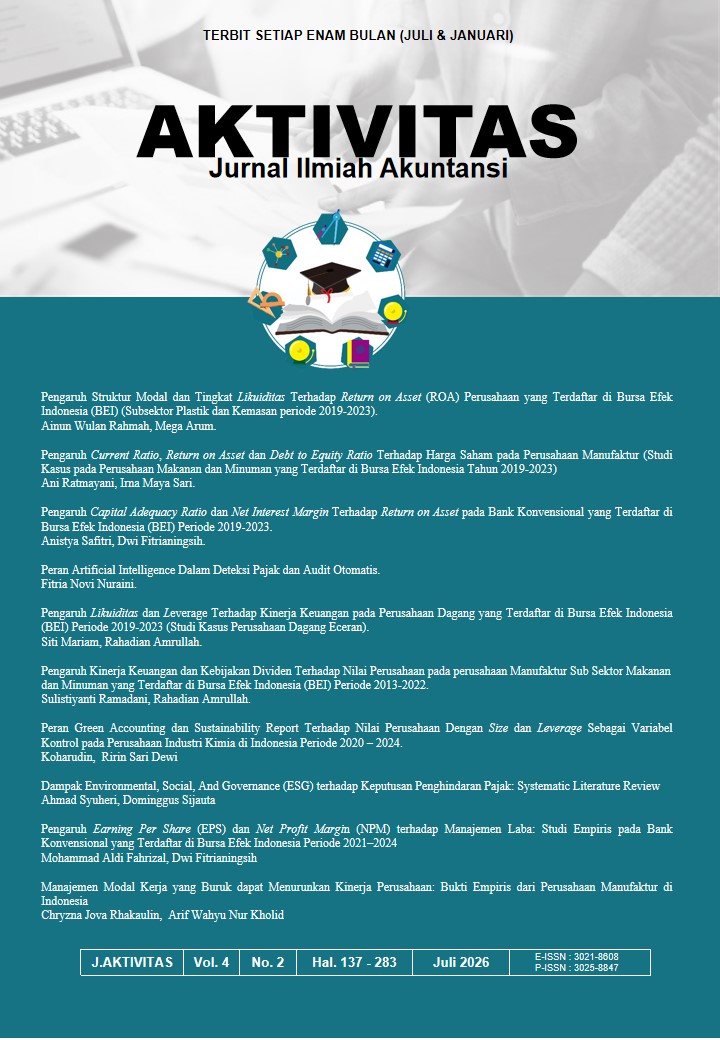
Manajemen Modal Kerja yang Buruk dapat Menurunkan Kinerja Perusahaan: Bukti Empiris dari Perusahaan Manufaktur di Indonesia
DOI:
https://doi.org/10.32493/aktivitas.v4i2.63092Keywords:
Manajemen Modal Kerja, Kinerja Perusahaan, Persediaan, Piutang Usaha, Utang UsahaAbstract
Industri manufaktur memiliki kebutuhan modal kerja yang besar karena siklus operasinya melibatkan pengadaan bahan baku, proses produksi, penyimpanan persediaan, penjualan kredit, dan pembayaran kepada pemasok. Pengelolaan modal kerja yang tidak efisien dapat menyebabkan dana terlalu lama tertahan dalam aktivitas operasional dan menurunkan profitabilitas perusahaan. Penelitian ini bertujuan menganalisis pengaruh periode persediaan, periode penagihan piutang usaha, dan periode pembayaran utang usaha terhadap kinerja perusahaan yang diproksikan dengan return on assets (ROA). Populasi penelitian mencakup perusahaan manufaktur yang terdaftar di Bursa Efek Indonesia pada tahun 2023. Dengan metode purposive sampling, diperoleh 112 perusahaan sebagai sampel. Data sekunder berasal dari laporan keuangan dan laporan tahunan perusahaan, kemudian dianalisis menggunakan regresi linear berganda serta Huber-White-Hinkley robust standard error. Hasil pengujian menunjukkan bahwa persediaan berpengaruh negatif dan signifikan terhadap ROA dengan koefisien −0,0985 dan probabilitas 0,0165. Piutang usaha juga berpengaruh negatif dan signifikan terhadap ROA dengan koefisien −0,0579 dan probabilitas 0,0000. Sementara itu, utang usaha berpengaruh negatif terhadap ROA dengan koefisien −0,1279 dan signifikan pada tingkat 10% dengan probabilitas 0,0721. Secara simultan, ketiga variabel berpengaruh signifikan terhadap ROA. Temuan ini mendukung Liquidity–Profitability Trade-off Theory bahwa perusahaan perlu menjaga modal kerja pada tingkat optimal agar likuiditas tetap terpelihara tanpa mengorbankan profitabilitas.
References
Agustiyana, R. A. (2022). Working capital management and profitability of manufacturing public company in Indonesia. Jurnal Studi Manajemen Organisasi, 17(2), 49–57. https://doi.org/10.14710/jsmo.v17i2.39217
Aryawan, I., & Indriani, A. (2020). Working capital management and profitability: Evidence from Indonesian manufacturing companies. Diponegoro International Journal of Business, 3(1), 36–46. https://doi.org/10.14710/dijb.3.1.2020.36-46
Badan Pusat Statistik. (2026, February 5). Ekonomi Indonesia tahun 2025 tumbuh 5,11 persen. https://www.bps.go.id/id/pressrelease/2026/02/05/2546/indonesia-s-economic-growth-in-2025-was-5-11-percent.html
Baños-Caballero, S., García-Teruel, P. J., & Martínez-Solano, P. (2014). Working capital management, corporate performance, and financial constraints. Journal of Business Research, 67(3), 332–338. https://doi.org/10.1016/j.jbusres.2013.01.016
Basyith, A., Djazuli, A., & Fauzi, F. (2021). Does working capital management affect profitability? Empirical evidence from Indonesia listed firms. Asian Economic and Financial Review, 11(3), 236–251. https://doi.org/10.18488/journal.aefr.2021.113.236.251
Deloof, M. (2003). Does working capital management affect profitability of Belgian firms? Journal of Business Finance & Accounting, 30(3–4), 573–588. https://doi.org/10.1111/1468-5957.00008
Enqvist, J., Graham, M., & Nikkinen, J. (2014). The impact of working capital management on firm profitability in different business cycles: Evidence from Finland. Research in International Business and Finance, 32, 36–49. https://doi.org/10.1016/j.ribaf.2014.03.005
García-Teruel, P. J., & Martínez-Solano, P. (2007). Effects of working capital management on SME profitability. International Journal of Managerial Finance, 3(2), 164–177. https://doi.org/10.1108/17439130710738718
Kementerian Perindustrian Republik Indonesia. (2026, February 5). Industri pengolahan mendominasi kinerja ekonomi nasional. https://sippa.kemenperin.go.id/news/post/2026/02/20/37/industri-pengolahan-mendominasi-kinerja-ekonomi-nasional
Kiymaz, H., Haque, S., & Choudhury, A. A. (2024). Working capital management and firm performance: A comparative analysis of developed and emerging economies. Borsa Istanbul Review, 24(3), 634–642.
Kristiana, D., & Karnasi, R. (2024). The effect of working capital management on profitability in manufacturing companies listed on the Indonesia Stock Exchange. Journal of Applied Business, Taxation and Economics Research, 3(3), 232–239. https://doi.org/10.54408/jabter.v3i3.255
Satoto, S. H., KP, H. N., & WS, S. B. (2022). Working capital management before and during the COVID-19 pandemic and their effect on profitability in manufacturing companies listed on the Indonesia Stock Exchange. International Journal of Economics, Business and Accounting Research, 6(3), 2119–2126. https://doi.org/10.29040/ijebar.v6i3.6493
Singhania, M., & Mehta, P. (2017). Working capital management and firms’ profitability: Evidence from emerging Asian countries. South Asian Journal of Business Studies, 6(1), 80–97. https://doi.org/10.1108/SAJBS-09-2015-0060
Wang, Y.-J. (2002). Liquidity management, operating performance, and corporate value: Evidence from Japan and Taiwan. Journal of Multinational Financial Management, 12(2), 159–169. https://doi.org/10.1016/S1042-444X(01)00047-0
Downloads
Published
How to Cite
Issue
Section
License
Copyright (c) 2026 Chryzna Jova Rhakaulin, Arif Wahyu Nur Kholid

This work is licensed under a Creative Commons Attribution-ShareAlike 4.0 International License.
Authors who publish with this journal agree to the following terms:
- Authors retain copyright and grant the journal right of first publication with the work simultaneously licensed under a Creative Commons Attribution License that allows others to share the work with an acknowledgement of the work's authorship and initial publication in this journal.
- Authors are able to enter into separate, additional contractual arrangements for the non-exclusive distribution of the journal's published version of the work (e.g., post it to an institutional repository or publish it in a book), with an acknowledgement of its initial publication in this journal.
- Authors are permitted and encouraged to post their work online (e.g., in institutional repositories or on their website) prior to and during the submission process, as it can lead to productive exchanges, as well as earlier and greater citation of published work (See The Effect of Open Access).

This work is licensed under a Creative Commons Attribution-ShareAlike 4.0 International License.