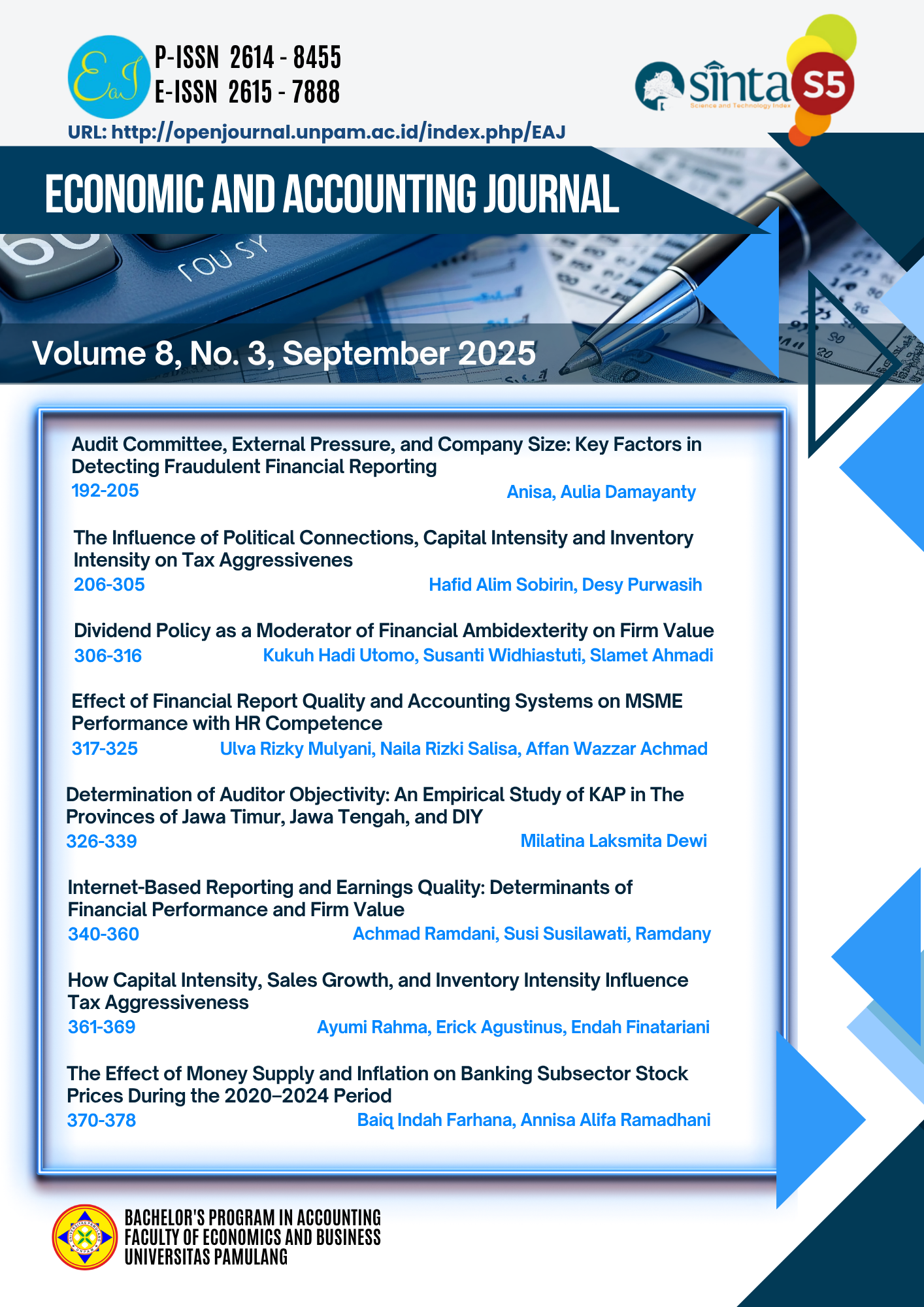
The Influence of Political Connections, Capital Intensity, and Inventory Intensity on Tax Aggressivenes
DOI:
https://doi.org/10.32493/eaj.v8i3.y2025.p206-305Keywords:
Tax Aggressiveness, Political Connection, Capital intensity, Inventory IntensityAbstract
This study aims to analyze the effect of Political Connection, Capital Intensity, and Inventory Intensity on Tax Aggressiveness in Consumer Non-Cyclicals Sector companies listed on the Indonesia Stock Exchange (IDX) in 2019-2023. The sampling method used in this study uses purposive sampling method, with quantitative research type. The data used is secondary data, the company's annual financial report. The number of samples used in this study were 24 companies in the in Consumer Non-Cyclicals Sector with observations for 5 (five) years, there are 120 observation objects were selected. The analysis technique used is path analysis to test the effect of intervening variable and uses the panel data regression method with the EViews version 13 application tool. The results showed that: 1) Political Connection has no affects Tax Aggressiveness, 2) Capital Intensity has affects Tax Aggressiveness, 3) Inventory Intensity has no affects Tax Aggressiveness, 4) Political Connections, Capital Intensity and Inventory Intensity have a positive and significant effect simultaneously on Tax Aggressiveness.
References
Alifa, A. R., Sinulingga, N. F., Sibarani, R. O., Waryu, & Suripto. (2018). The Effect of Corporate Social Responsibility, Capital Intensity, and Political Connections on Tax Aggressiveness. Jurnal Perpajakan Dan Akuntansi, 104–117.
Ariska, M., Fahru, M., & Kusuma, J. W. (2020). Leverage, Company Size, and Profitability and Their Influence on Tax Avoidance in Mining Sector Companies Listed on the Indonesia Stock Exchange (2014–2019). Jurnal Revenue: Jurnal Ilmiah Akuntansi, 1(1), 133–142.
Bintoro, C. S. (2022). Analysis of Factors Affecting Foreign Direct Investment in Indonesia. Jurnal Economina, 1(3), 547–562.
Damayanti, A. P., & Suryaningrum, D. H. (2023). The Effect of Government Expenditures in the Health and Education Sectors on the Human Development Index (HDI). Jurnal Maneksi, 12(3), 614–627.
Efrinal, E., & Chandra, A. H. (2020). The Influence of Capital Intensity and Inventory Intensity on Tax Aggressiveness. AKRUAL: Jurnal Akuntansi Dan Keuangan, 2(2), 135–148.
Febriana, A., & Pratiwi, A. P. (2023). Tax Aggressiveness: Earnings Management, Independent Commissioners, and Inventory Intensity. Jurnal Penelitian Ekonomi Akuntansi (JENSI), 7(2), 424–437.
Ghifary, R. A., & Lastati, H. S. (2024). The Effect of Capital Intensity, Inventory Intensity, Profitability, and Political Connections on Tax Aggressiveness with Independent Commissioners as a Moderating Variable. Jurnal Ekonomi & Keuangan, 5(1), 39–55.
Handayani, R. S., & Utomo, R. B. (2023). The Effect of Political Connections, Bonus Mechanisms, and Leverage on Tax Aggressiveness. Jurnal Ilmiah Manajemen, Ekonomi, & Akuntansi (MEA), 7(3), 1546–1567.
Jamalallail, U. F., & Indarti, M. G. K. (2022). Determinants of Tax Evasion with Religiosity as a Moderating Variable. KRISNA: Kumpulan Riset Akuntansi, 14(1), 93–106.
Jannatul Aulia, & Bashori. (2024). Developing a Theoretical Framework in Research. Universitas Islam Negeri Antasari Banjarmasin, 1–5.
Kambono, H. (2020). The Influence of Foreign and Domestic Investment on Indonesia’s Economic Growth. Jurnal Akuntansi, 12(1), 137–145.
Laksmi, K. W., Ariwangsa, I. G. N. O., Putri, N. P. A. S. D., & Putra, K. W. S. (2024). The Effect of Liquidity, Leverage, Profitability, and Capital Intensity on Tax Aggressiveness. Indonesian Journal of Management Studies, 2(3), 1–10.
Lestari, A., Indrawan, I. G. A., & Sasana, L. P. W. S. (2024). Factors of Tax Avoidance in Consumer Non-Cyclical Companies Listed on the Indonesia Stock Exchange. Jurnal Riset Pendidikan Ekonomi (JRPE), 9(1), 78–90.
Maulana, T., B, A. A. P., & Marlina, E. (2022). The Effect of Capital Intensity, Inventory Intensity, and Leverage on Tax Aggressiveness (A Study on IDX-Listed Mining Companies 2017–2021). SCIENTIFIC JOURNAL OF REFLECTION: Economic, Accounting, Management and Business, 5(3), 829–842.
Murni Ria Lestari, & Pratiwi, A. P. (2024). The Effect of Capital Intensity, Inventory Intensity, Debt Policy, and Income Smoothing on Tax Aggressiveness. Akuntansi Pajak Dan Kebijakan Ekonomi Digital, 1(3), 210–218.
Prasetyo, A., & Sartika Wulandari. (2021). Capital Intensity, Leverage, Return on Assets, and Company Size on Tax Aggressiveness. Jurnal Akuntansi, Program Studi Akuntansi, 13(1), 134–147.
Pratiwi, L. A., Ningsih, N. A., Amaliah, F., & Tiara Sri Intan. (2024). The Influence of QRIS Digital Payment Adoption on Sales Revenue Growth in MSMEs. Jurnal Bisnis Kolega, 10(1), 12–23.
Ramdhani, D., Hasanah, D. N., Pujangga, A. M., & Ahdiat, D. (2022). The Influence of Corporate Social Responsibility, Leverage, Inventory Intensity, and Political Connections on Tax Aggressiveness in Property and Real Estate Companies Listed on the Indonesia Stock Exchange. STATERA: Jurnal Akuntansi Dan Keuangan, 4(1), 1–16.
Riswandari, E., & Bagaskara, K. (2020). Tax Aggressiveness Affected by Executive Compensation, Political Connections, Sales Growth, Leverage, and Profitability. Jurnal Akuntansi, 10(3), 261–274.
Rusli, Y. M. (2021). Corporate Tax Aggressiveness During the COVID-19 Pandemic in Indonesia and Malaysia, Moderated by Financial Performance. Jurnal Analisa Akuntansi Dan Perpajakan, 5(2), 176–195.
Sawitri, A. P., Alam, W. Y., & Dewi, F. A. A. (2022). The Effect of Profitability, Sales Growth, Company Size, and Political Connections on Tax Avoidance. Jurnal Riset Akuntansi Mercu Buana, 8(1), 44–52.
Sugiarto, A. I., & Damayanti, R. (2023). The Effect of Financial Stability, Free Cash Flow, and Capital Intensity on Earnings Management (An Empirical Study on Consumer Non-Cyclical Companies Listed on the Indonesia Stock Exchange 2018–2022). Jurnal Economina, 2(12), 3777–3786.
Sugiyono, D. (2010). Quantitative, Qualitative, and R&D Research Methods. Penerbit Alfabeta
Additional Files
Published
Issue
Section
License
Copyright (c) 2025 Hafid Alim Sobirin, Desy Purwasih

This work is licensed under a Creative Commons Attribution-ShareAlike 4.0 International License.
Authors who publish with this journal agree to the following terms:
- Authors retain copyright and grant the journal right of first publication with the work simultaneously licensed under a Creative Commons Attribution License that allows others to share the work with an acknowledgement of the work's authorship and initial publication in this journal.
- Authors are able to enter into separate, additional contractual arrangements for the non-exclusive distribution of the journal's published version of the work (e.g., post it to an institutional repository or publish it in a book), with an acknowledgement of its initial publication in this journal.
- Authors are permitted and encouraged to post their work online (e.g., in institutional repositories or on their website) prior to and during the submission process, as it can lead to productive exchanges, as well as earlier and greater citation of published work (See The Effect of Open Access).

This work is licensed under a Creative Commons Attribution-ShareAlike 4.0 International License.
 PUBLICATION ETHICS
 FOCUS AND SCOPE
 EDITORIAL TEAM
 REVIEW PROCESS
 CONTACT US
 AUTHOR GUIDELINES