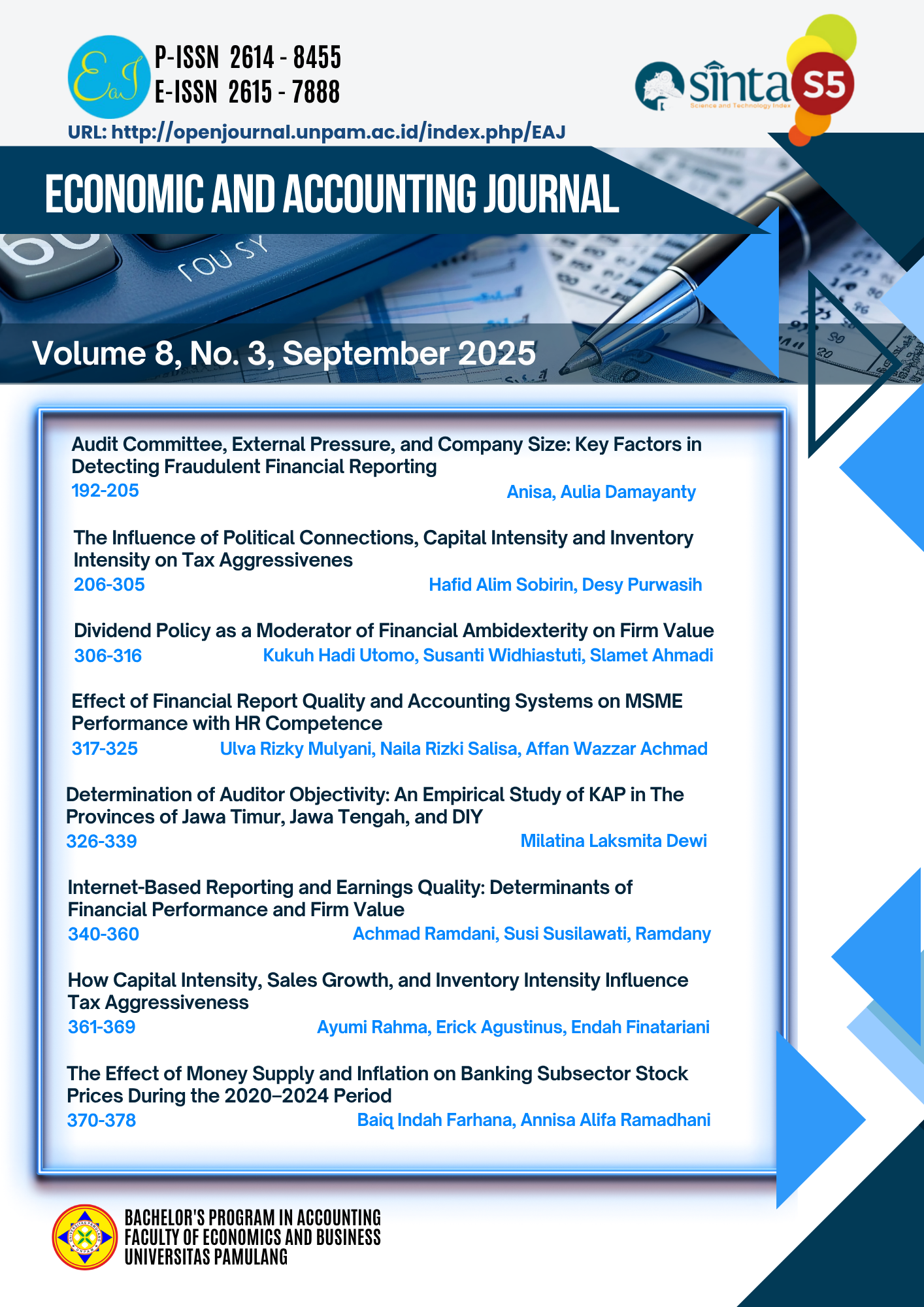
Effect of Financial Report Quality and Accounting Systems on MSME Performance with HR Competence
DOI:
https://doi.org/10.32493/eaj.v8i3.y2025.p317-325Keywords:
Financial Statement Quality, Accounting System Usage, MSME Performance, Human Resource CompetencyAbstract
Micro, Small, and Medium Enterprises (MSMEs) play a crucial role in regional economic development, particularly in areas such as Kudus Regency, where they serve as a backbone of local industry and employment. However, their performance is often constrained by limited financial management practices and a lack of competent human resources. This study examines the effect of financial statement quality and accounting system usage on the performance of MSMEs, with human resource competency as a moderating variable. Using a quantitative approach, data were collected through questionnaires from MSME actors in Kudus Regency, selected via simple random sampling. The analysis employed Moderated Regression Analysis (MRA). Results reveal that financial statement quality has a negative and insignificant effect on MSME performance, while accounting system usage has a positive and significant effect. Furthermore, human resource competency positively moderates the relationships between both financial statement quality and accounting system usage with MSME performance.
References
Hadiwibowo, A., Rahayu, S., & Pradana, I. (2024). The impact of accounting information systems and HR competence on MSMEs’ performance mediated by e-commerce. International Journal of Economics, Business and Management Research, 8(7), 50–63. https://www.researchgate.net/publication/383310149
Hernawati, N., Kuntorini, R. S., Pramono, I. P., Akuntansi, P., Ekonomi, F., & Bisnis, D. (2019). Pengaruh Pengetahuan Laporan Keuangan Terhadap Kinerja UMKM Tahu Cibuntu Application of Knowledge of Financial Statements On the Performance UMKM Cibuntu Tofu.
Ikatan Akuntan Indonesia. (2018). Standar Akuntansi Keuangan Entitas Mikro, Kecil, dan Menengah. Dewan Standar Akuntansi Keuangan Ikatan Akuntan Indonesia.
Mulyani, U. R. (2022). The Influence Of MSME Perceptions Of Accounting On The Use Of Accounting Information. Monex, 11(01), 39–48. https://ejournal.poltektegal.ac.id/index.php/monex/article/download/2920/1626
Mulyani, U.R., Diah A.S., Nilnal M.C. (2022). Pelatihan Laporan Keuangan Berbasis Syariah Bagi Kelompok Usaha Perectakan AUFA Creative Media Desa Rejosari Kecamatan Dawe, Kabupaten Kudus. Buletin Abdi Masyarakat. Vol 3 No 1 hal 48-52
Pakpahan, yunita E. (2020). Analisis LAporan Keuangan dan Pengguanaan sistem infromasi akuntansi. Universitas Quality Berastagi.
Silaen, S. (2018). Metodologi Penelitian Sosial untuk Penulisan Skripsi dan Tesis. Bogor: Penerbit In Media.
Sulistiyo, A., Putranto, A., & Hartiyah, S. (2022). Pengaruh Literasi Keuangan, Kompetensi Sumberdaya Manusia, Inovasi Produk, Dan Akses Pemasaran Terhadap Kinerja UMKM Di Kabupaten Wonosobo. Jamasy: Jurnal Akuntansi, Manajemen & Perbankan Syariah, 2(1), 97–113.
Taufiq, M., Prihatni, R., & v bhGurendrawati, E. (2020). Pengaruh Inovasi Produk, Kualitas Produk dan Penggunaan Sistem Akuntansi Terhadap Kinerja UMKM. Jurnal Akuntansi, Perpajakan Dan Auditing, 1(2), 204–220. https://doi.org/10.21009/japa.0102.05
Utami, L. S., & Sudrajat, D. (2023). Pengaruh kualitas laporan keuangan dan penggunaan teknologi akuntansi terhadap kinerja UMKM. Indonesian Journal of Economics, Development and Research, 4(2), 145–156. https://journal.yrpipku.com/index.php/ijedr/article/view/3366
Winarso, B. S., & Kurniawati, I. (2022). Pengaruh Kemampuan Penyusunan Laporan Keuangan, Kompetensi UMKM dan Latar belakang pendidikan terhadap Kinerja UMKM. Journal Competency of Business, 6(01), 26–37. https://doi.org/10.47200/jcob.v6i01.1289
Yuttama, I. P. A., & Jaya, I. K. (2025). Digital accounting systems and MSMEs’ financial performance: Evidence from Indonesia. Green Inflation: International Journal of Economics and Business, 2(1), 27–39. https://international.arimbi.or.id/index.php/GreenInflation/article/view/331
Additional Files
Published
Issue
Section
License
Copyright (c) 2025 Ulva Rizky Mulyani, Naila Rizki Salisa, Affan Wazzar Achmad

This work is licensed under a Creative Commons Attribution-ShareAlike 4.0 International License.
Authors who publish with this journal agree to the following terms:
- Authors retain copyright and grant the journal right of first publication with the work simultaneously licensed under a Creative Commons Attribution License that allows others to share the work with an acknowledgement of the work's authorship and initial publication in this journal.
- Authors are able to enter into separate, additional contractual arrangements for the non-exclusive distribution of the journal's published version of the work (e.g., post it to an institutional repository or publish it in a book), with an acknowledgement of its initial publication in this journal.
- Authors are permitted and encouraged to post their work online (e.g., in institutional repositories or on their website) prior to and during the submission process, as it can lead to productive exchanges, as well as earlier and greater citation of published work (See The Effect of Open Access).

This work is licensed under a Creative Commons Attribution-ShareAlike 4.0 International License.
 PUBLICATION ETHICS
 FOCUS AND SCOPE
 EDITORIAL TEAM
 REVIEW PROCESS
 CONTACT US
 AUTHOR GUIDELINES