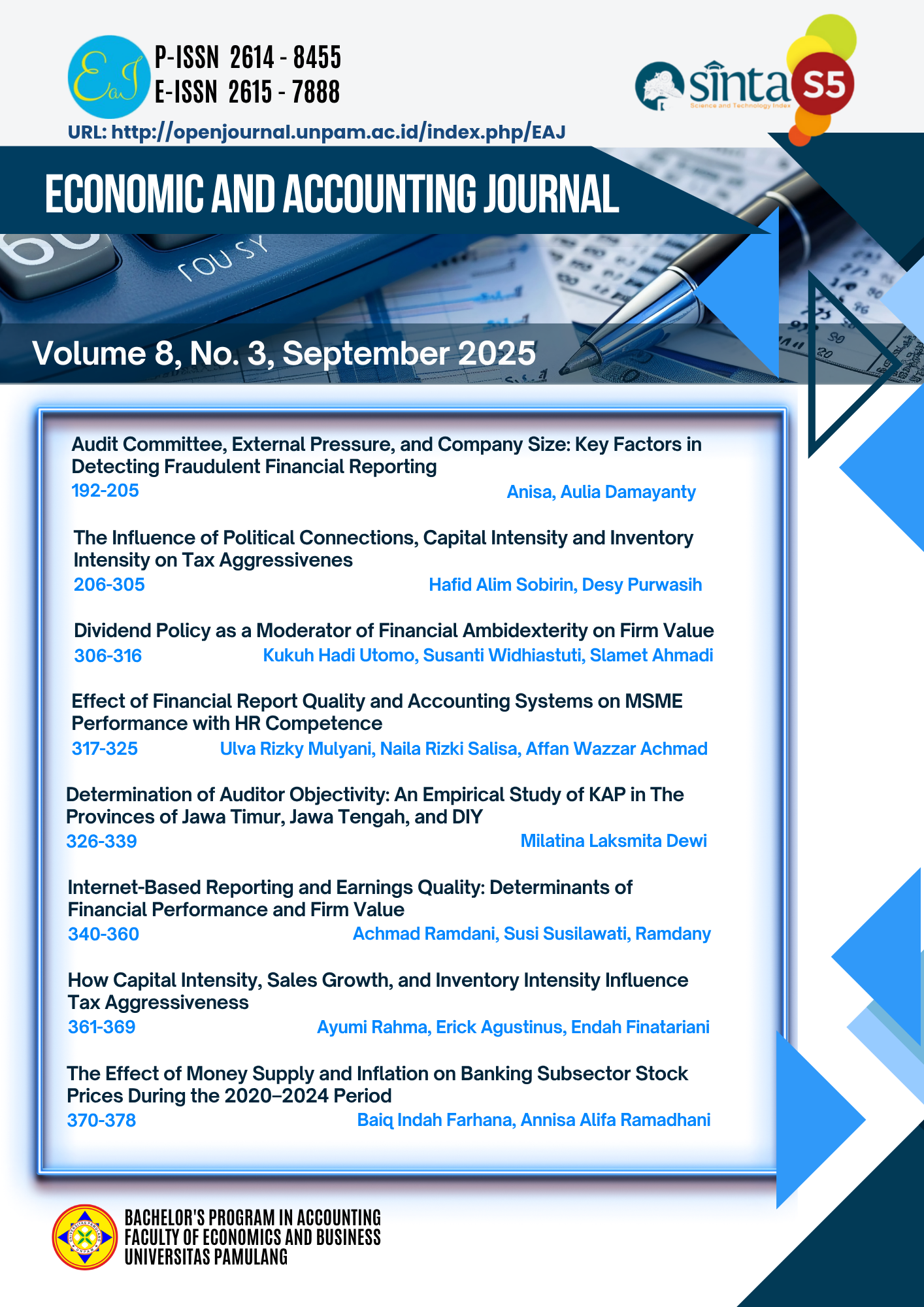
How Capital Intensity, Sales Growth, and Inventory Intensity Influence Tax Aggressiveness
DOI:
https://doi.org/10.32493/eaj.v8i3.y2025.p361-369Keywords:
tax aggressiveness, Capital Intensity, Sales Growth, Inventory IntensityAbstract
Taxation constitutes a major component of government revenue, serving as a crucial instrument for financing public expenditures and supporting national development programs. On the other hand, corporations tend to view taxes as a reduction in earnings and therefore seek ways to reduce the burden, one of which is through tax aggressiveness. Although still within the boundaries of tax regulations, such practices diminish potential state revenue and remain a concern for policymakers. This research explores the influence of capital intensity, sales growth, and inventory intensity on corporate tax aggressiveness. The study focuses on firms in the food and beverage sub-sector listed on the Indonesia Stock Exchange between 2019 and 2023. The sample was determined using purposive sampling in line with predetermined criteria, while panel data regression was employed for hypothesis testing. The findings reveal that capital intensity, sales growth, and inventory intensity jointly exert a significant impact on tax aggressiveness. Moreover, partial analysis confirms that each variable individually contributes to explaining variations in tax aggressiveness. These results underscore the importance of firm-level financial policies in shaping corporate tax behavior.
References
Andhari, P. A. S., & Sukartha, I. M. (2017). Pengaruh pengungkapan corporate social responsibility, profitabilitas, inventory intensity, capital intensity dan leverage pada agresivitas pajak. E-Jurnal Akuntansi, 18(3), 2115–2142.
Antari, N. K. D. P., & Merkusiwati, N. K. L. A. (2022). Ukuran perusahaan, leverage, sales growth dan agresivitas pajak. E-Jurnal Akuntansi, 32(1), 1–15.
Ayem, S., & Setyadi, A. (2019). Pengaruh profitabilitas, ukuran perusahaan, komite audit dan capital intensity terhadap agresivitas pajak. Jurnal Akuntansi Pajak Dewantara, 1(2), 228–241. https://doi.org/10.24964/japd.v1i1.905
Dharma, N. B. S., & Noviari, N. (2017). Pengaruh corporate social responsibility dan capital intensity terhadap tax avoidance. E-Jurnal Akuntansi Universitas Udayana, 18(1), 529–556.
Ghozali, I. (2017). Analisis multivariat dan ekonometrika: Teori, konsep, dan aplikasi dengan Eviews 10 (Edisi 2). Semarang: Badan Penerbit Universitas Diponegoro.
Ghozali, I. (2018). Aplikasi analisis multivariate dengan program IBM SPSS 25 (Edisi 9). Semarang: Badan Penerbit Universitas Diponegoro.
Hidayat, A. T., & Fitria, E. F. (2018). Pengaruh capital intensity, inventory intensity, profitabilitas dan leverage terhadap agresivitas pajak. Eksis: Jurnal Riset Ekonomi dan Bisnis, 13(2), 157–168.
Indradi, D. (2018). Pengaruh likuiditas, capital intensity terhadap agresivitas pajak (Studi empiris pada perusahaan manufaktur sub sektor industri dasar dan kimia yang terdaftar di BEI tahun 2012–2016). Jurnal Akuntansi Berkelanjutan Indonesia (JABI), 1(1), 147–167.
Jensen, M. C., & Meckling, W. H. (1976). Theory of the firm: Managerial behaviour, agency cost and ownership structure. Journal of Financial Economics, 3(4), 305–360.
Kuncoro, M. (2013). Metode riset untuk bisnis dan ekonomi. Jakarta: Erlangga.
Mustika, M., Ratnawati, V., & Silfi, A. (2017). Pengaruh corporate social responsibility, ukuran perusahaan, profitabilitas, leverage, capital intensity dan kepemilikan keluarga terhadap agresivitas pajak (Studi empiris pada perusahaan pertambangan dan pertanian yang terdaftar pada Bursa Efek Indonesia). (Doctoral dissertation, Universitas Riau).
Ningsih, N. P. M., & Noviari, N. (2022). Pengaruh profitabilitas, likuiditas, ukuran perusahaan, intensitas persediaan, dan pertumbuhan penjualan pada agresivitas pajak. E-Jurnal Ekonomi dan Bisnis Universitas Udayana, 11(9), 1002–1020.
Nugraha, N. B., & Meiranto, W. (2015). Pengaruh corporate social responsibility, ukuran perusahaan, profitabilitas, leverage dan capital intensity terhadap agresivitas pajak (Studi empiris pada perusahaan non keuangan yang terdaftar di Bursa Efek Indonesia 2012–2013). Diponegoro Journal of Accounting, 4(4), 1–14.
Ramadhani, W. S., Triyanto, D. N., & Kurnia, K. (2020). Pengaruh hedging, financial lease dan sales growth terhadap agresivitas pajak. Journal of Applied Accounting and Taxation, 5(1), 107–116.
Savitri, D. A. M., & Rahmawati, I. N. (2017). Pengaruh leverage, intensitas persediaan, intensitas aset tetap, dan profitabilitas terhadap agresivitas pajak. Jurnal Ilmu Manajemen dan Akuntansi Terapan (JIMAT), 8(2), 19–32.
Sugiyono. (2018). Metode penelitian bisnis: Pendekatan kuantitatif, kualitatif, dan R&D. Bandung: Alfabeta.
Yuliana, I. F., & Wahyudi, D. (2018). Likuiditas, profitabilitas, leverage, ukuran perusahaan, capital intensity dan inventory intensity terhadap agresivitas pajak (Studi empiris pada perusahaan manufaktur yang terdaftar di Bursa Efek Indonesia tahun 2013–2017). Dinamika Akuntansi, Keuangan dan Perbankan, 7(2), 120–134.
Additional Files
Published
Issue
Section
License
Copyright (c) 2025 Ayumi Rahma, Erick Agustinus, Endah Finatariani

This work is licensed under a Creative Commons Attribution-ShareAlike 4.0 International License.
Authors who publish with this journal agree to the following terms:
- Authors retain copyright and grant the journal right of first publication with the work simultaneously licensed under a Creative Commons Attribution License that allows others to share the work with an acknowledgement of the work's authorship and initial publication in this journal.
- Authors are able to enter into separate, additional contractual arrangements for the non-exclusive distribution of the journal's published version of the work (e.g., post it to an institutional repository or publish it in a book), with an acknowledgement of its initial publication in this journal.
- Authors are permitted and encouraged to post their work online (e.g., in institutional repositories or on their website) prior to and during the submission process, as it can lead to productive exchanges, as well as earlier and greater citation of published work (See The Effect of Open Access).

This work is licensed under a Creative Commons Attribution-ShareAlike 4.0 International License.
 PUBLICATION ETHICS
 FOCUS AND SCOPE
 EDITORIAL TEAM
 REVIEW PROCESS
 CONTACT US
 AUTHOR GUIDELINES