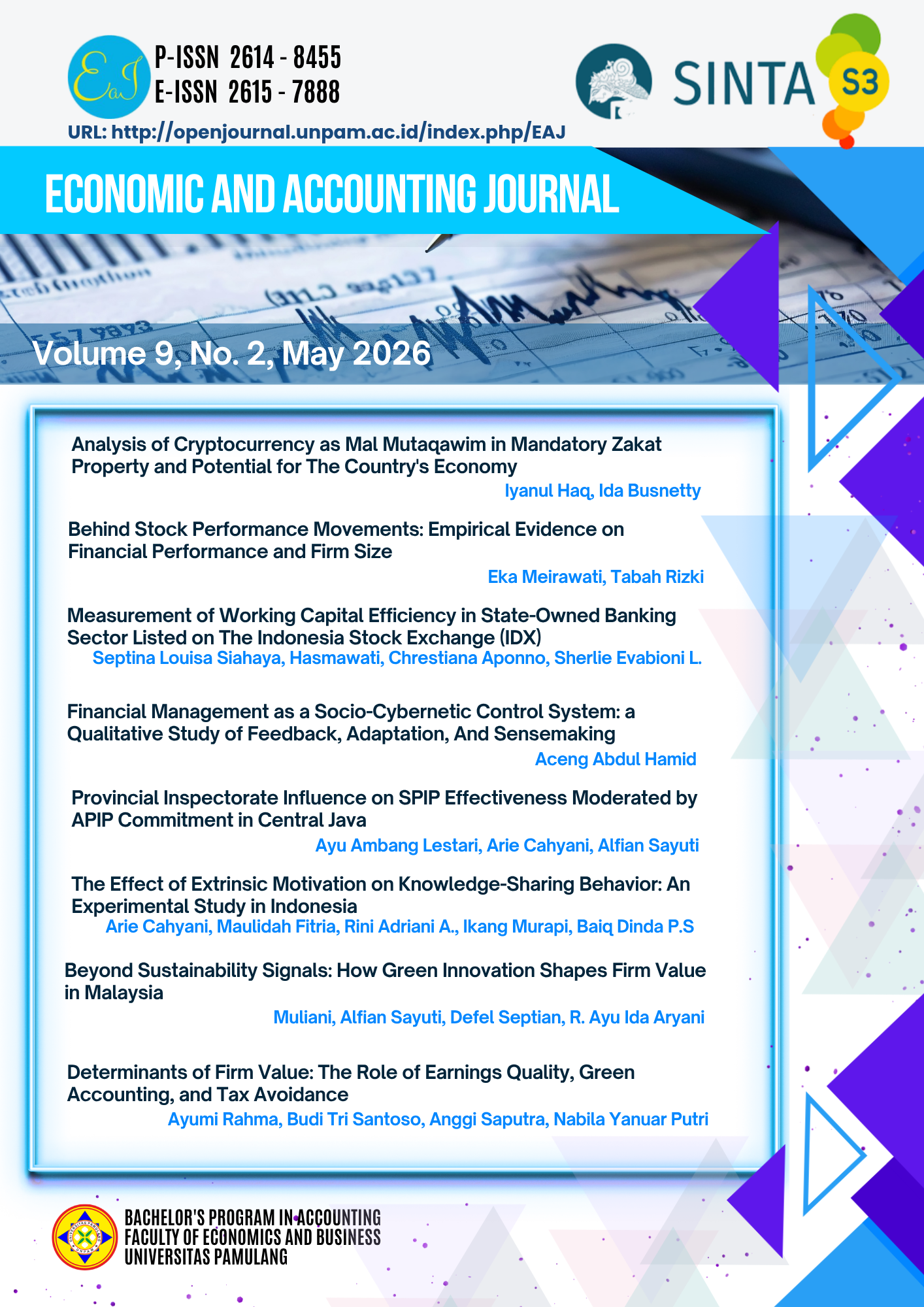
Financial Management as a Socio-Cybernetic Control System: a Qualitative Study of Feedback, Adaptation and Sensemaking
DOI:
https://doi.org/10.32493/eaj.v9i2.y2026.p134-142Keywords:
Financial Control, Cybernetics, Sensemaking, Adaptive Control, FeedbackAbstract
This study reconceptualizes financial management as a socio-cybernetic control system embedded within organizational processes of feedback, adaptation, and sensemaking. Existing financial management literature has predominantly emphasized rational, static, and optimization-based models, which are increasingly insufficient to explain decision-making under conditions of uncertainty and organizational complexity. This research adopts a qualitative multiple case study approach, using semi-structured interviews, internal financial documents, and observational data to explore how financial control operates in practice. The findings reveal that financial management functions as a recursive and adaptive system in which financial information is continuously interpreted, negotiated, and reconfigured through feedback loops and organizational interactions. Based on these findings, this study develops a novel framework Socio-Cybernetic Financial Control (SCFC) which integrates feedback mechanisms, adaptive control processes, and behavioral mediation into a unified model. The framework highlights that financial control is not merely a technical function but a socially embedded process shaped by interpretation, power dynamics, and contextual influences. This research contributes to the literature by extending management control and financial management theories through a dynamic, systems-based, and interpretive perspective, while also offering practical insights for designing adaptive and feedback-driven financial systems in complex organizational environments.
References
Beer, S. (1972). Brain of the firm. London: Allen Lane.
Bisbe, J., & Otley, D. (2004). The effects of the interactive use of management control systems. Accounting, Organizations and Society, 29(8), 709–737.
Cyert, R. M., & March, J. G. (1963). A behavioral theory of the firm. Englewood Cliffs: Prentice-Hall.
Fama, E. F. (1970). Efficient capital markets: A review of theory and empirical work. Journal of Finance, 25(2), 383–417.
Glaser, B. G., & Strauss, A. L. (1967). The discovery of grounded theory: Strategies for qualitative research. Chicago: Aldine.
Hall, M. (2016). Realizing the richness of psychology in contingency-based management accounting research. Accounting, Organizations and Society, 51, 63–74.
Hamid, A. A., Siagian, A., Razak, A., & Endri, E. (2019). Determinants of bond rating and its implications to corporate bond yield. International Journal of Engineering and Advanced Technology (IJEAT), 9(2).doi:10.35940/ijeat.B3358.129219
Hamid, A. A. (2026). Obligasi korporasi di Bursa Efek Indonesia: Konsep, risiko, dan kinerja perusahaan. Pekanbaru : CV Bravo Press Indonesia.
Hamid, A. A. (2026). Corporate financial management & investment analysis. Pekanbaru : CV Bravo Press Indonesia.
Hopwood, A. G. (1972). An empirical study of the role of accounting data in performance evaluation. Journal of Accounting Research, 10, 156–182.
Jordan, S., & Messner, M. (2012). Enabling control and the problem of incomplete performance indicators. Accounting, Organizations and Society, 37(8), 544–564.
Kahneman, D. (2011). Thinking, fast and slow. New York: Farrar, Straus and Giroux.
March, J. G., & Simon, H. A. (1958). Organizations. New York: Wiley.
Miller, P., & Power, M. (2013). Accounting, organizing, and economizing: Connecting accounting research and organization theory. Accounting, Organizations and Society, 38(8), 557–605.
Mintzberg, H. (1978). Patterns in strategy formation. Management Science, 24(9), 934–948.
Otley, D. (1999). Performance management: A framework for management control systems research. Management Accounting Research, 10(4), 363–382.
Power, M. (2007). Organized uncertainty: Designing a world of risk management. Oxford: Oxford University Press.
Simons, R. (1995). Levers of control: How managers use innovative control systems. Boston: Harvard Business School Press.
Strauss, A., & Corbin, J. (2008). Basics of qualitative research: Techniques and procedures for developing grounded theory. Thousand Oaks: Sage.
Tessier, S., & Otley, D. (2012). A conceptual development of management control systems. Management Accounting Research, 23(3), 171–185.
Weick, K. E. (1995). Sensemaking in organizations. Thousand Oaks: Sage Publications.
Wiener, N. (1961). Cybernetics: Or control and communication in the animal and the machine. Cambridge: MIT Press.
Additional Files
Published
Issue
Section
License
Copyright (c) 2026 Aceng Abdul Hamid

This work is licensed under a Creative Commons Attribution-ShareAlike 4.0 International License.
Authors who publish with this journal agree to the following terms:
- Authors retain copyright and grant the journal right of first publication with the work simultaneously licensed under a Creative Commons Attribution License that allows others to share the work with an acknowledgement of the work's authorship and initial publication in this journal.
- Authors are able to enter into separate, additional contractual arrangements for the non-exclusive distribution of the journal's published version of the work (e.g., post it to an institutional repository or publish it in a book), with an acknowledgement of its initial publication in this journal.
- Authors are permitted and encouraged to post their work online (e.g., in institutional repositories or on their website) prior to and during the submission process, as it can lead to productive exchanges, as well as earlier and greater citation of published work (See The Effect of Open Access).

This work is licensed under a Creative Commons Attribution-ShareAlike 4.0 International License.
 PUBLICATION ETHICS
 FOCUS AND SCOPE
 EDITORIAL TEAM
 REVIEW PROCESS
 CONTACT US
 AUTHOR GUIDELINES