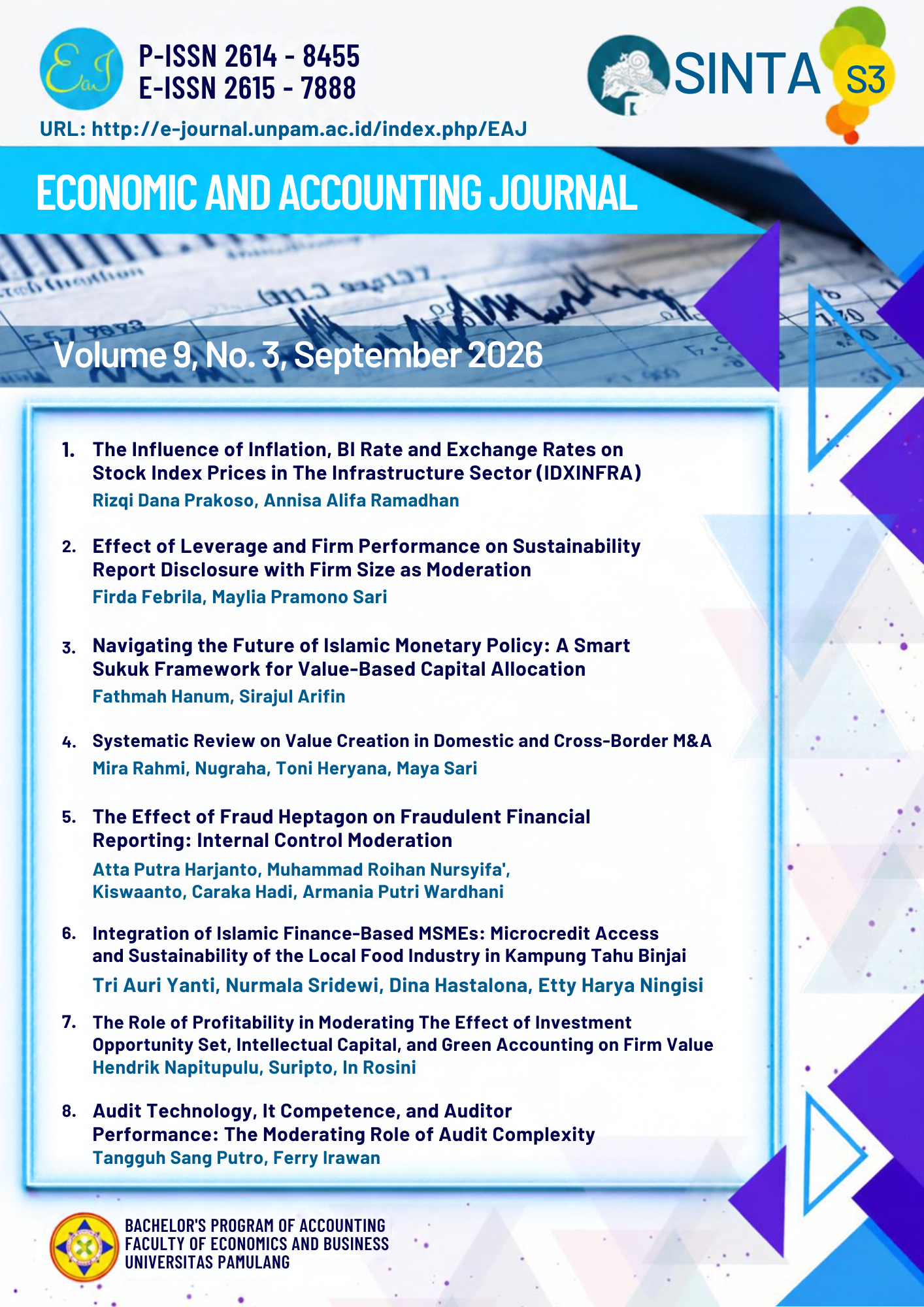
Integration of Islamic Finance-Based MSMEs: Microcredit Access and Sustainability of the Local Food Industry in Kampung Tahu Binjai
DOI:
https://doi.org/10.32493/eaj.v9i3.y2026.p267-279Keywords:
MSMEs, Islamic Finance, Microcredit Access, Sustainability, Local Food IndustryAbstract
This study aims to analyze the role of Islamic finance-based microcredit access in enhancing the sustainability of micro, small, and medium enterprises (MSMEs) in the local food industry of Kampung Tahu Binjai, with Islamic financial integration as a mediating variable. This research employs a quantitative approach using the Structural Equation Modeling–Partial Least Squares (SEM-PLS) method. Data were collected through questionnaires distributed to MSME actors using a purposive sampling technique. The results indicate that access to Islamic microcredit has a positive and significant effect on MSME sustainability. Furthermore, Islamic microcredit access is also found to significantly influence Islamic financial integration, suggesting that financing serves as an entry point for business actors to engage in the formal financial system. Islamic financial integration itself has a positive impact on MSME sustainability, emphasizing the importance of not only access to financing but also the optimal utilization of financial services. Moreover, the findings reveal that Islamic financial integration acts as a partial mediator in the relationship between Islamic microcredit access and MSME sustainability. Theoretically, this study contributes to the development of an integrative model linking financing access, financial integration, and MSME sustainability within the context of Islamic finance. Practically, these findings provide implications for policymakers and Islamic financial institutions to not only expand access to financing but also strengthen financial literacy and integration to support sustainable MSME development.
References
Abedifar, P., Molyneux, P., & Tarazi, A. (2013). Risk in Islamic banking. Review of Finance, 17(6), 2035–2096.https://doi.org/10.1093/rof/rfs041
Antonio, M. S., Sanrego, Y. D., & Taufiq, M. (2020). An analysis of Islamic microfinance models for poverty alleviation. International Journal of Islamic and Middle Eastern Finance and Management, 13(3), 519–536. https://doi.org/10.1108/IMEFM-08-2019-0268
Ascarya, A., Rahmawati, S., & Tanjung, H. (2015). Design of Islamic financial inclusion roadmap in Indonesia. Journal of Islamic Economics and Finance, 1(1), 1–22.
Ayyagari, M., Demirgüç-Kunt, A., & Maksimovic, V. (2011). Small vs. young firms across the world: Contribution to employment, job creation, and growth. World Bank Policy Research Working Paper No. 5631. https://doi.org/10.1596/1813-9450-5631
Beck, T., Demirgüç-Kunt, A., & Levine, R. (2005). SMEs, growth, and poverty: Cross-country evidence. Journal of Economic Growth, 10(3), 199–229. https://doi.org/10.1007/s10887-005-3533-5
Demirgüç-Kunt, A., Klapper, L., Singer, D., Ansar, S., & Hess, J. (2018). The Global Findex Database 2017: Measuring financial inclusion and the fintech revolution. World Bank. https://doi.org/10.1596/978-1-4648-1259-0
Hair, J. F., Hult, G. T. M., Ringle, C. M., Sarstedt, M., Danks, N. P., & Ray, S. (2022). Partial least squares structural equation modeling (PLS-SEM) using R: A workbook. Springer. https://doi.org/10.1007/978-3-030-80519-7
Hasan, M., & Dridi, J. (2010). The effects of the global crisis on Islamic and conventional banks: A comparative study. IMF Working Paper, WP/10/201. https://doi.org/10.5089/9781455201296.001
Hassan, M. K., Aliyu, S., Huda, M., & Rashid, M. (2022). Islamic finance and financial inclusion: A survey. Journal of Economic Surveys, 36(2), 446–478. https://doi.org/10.1111/joes.12428
Hj Talip SNS, Wasiuzzaman S (2024), "Influence of human capital and social capital on MSME access to finance: assessing the mediating role of financial literacy". International Journal of Bank Marketing, Vol. 42 No. 3 pp. 458–485, doi: https://doi.org/10.1108/IJBM-04-2023-0214
Jegerson D, Mertzanis C, Khan M (2025;), "Emerging trends in Fintech and Islamic finance: acomprehensive review". Journal of Islamic Marketing, Vol. ahead-of-print No. ahead-of-print. https://doi.org/10.1108/JIMA-07-2023-0218
Lawhaishy ZB, Othman AHA (2023), "Introducing an Islamic equity-based microfinance models for MSMEs in the State of Libya". Qualitative Research in Financial Markets, Vol. 15 No. 1 pp. 1–28, doi: https://doi.org/10.1108/QRFM-01-2021-0017
Ningsi, E. H., Yanti, T. A., & Nurhadi, A. A. (2025). Edukasi Literasi Keuangan Dalam Community Service Sebagai Strategi Peningkatan Akses Mobility Berkredit. Jurnal Pengabdian Masyarakat Aufa (JPMA), 7(2). https://doi.org/10.51933/jpma.v7i2.2021
Nitzl, C., Roldán, J. L., & Cepeda, G. (2021). Mediation analysis in partial least squares path modeling: Helping researchers discuss more sophisticated models. Industrial Management & Data Systems, 121(9), 1871–1895. https://doi.org/10.1108/IMDS-10-2020-0595
Obaidullah, M., & Khan, T. (2021). Islamic microfinance development: Challenges and opportunities. Islamic Economic Studies, 29(1), 1–20. https://doi.org/10.1108/IES-07-2021-0012
Ozili, P. K. (2021). Financial inclusion research around the world: A review. Forum for Social Economics, 50(4), 457–479. https://doi.org/10.1080/07360932.2020.1715238
Sarstedt, M., Ringle, C. M., & Hair, J. F. (2021). Partial least squares structural equation modeling. In C. Homburg et al. (Eds.), Handbook of market research (pp. 1–47). Springer. https://doi.org/10.1007/978-3-319-57413-4_15
Setiawan, B., Yusliza, M. Y., & Saputra, J. (2022). Financial literacy and MSMEs performance: The mediating role of access to finance. Sustainability, 14(5), 2700. https://doi.org/10.3390/su14052700
World Bank. (2022). Small and medium enterprises (SMEs) finance: Improving SMEs’ access to finance and finding innovative solutions. World Bank Group.
Yanti, T. A., Ramadhan, M., & Yafiz, M. (2025). Utilization of Technology as a Strategic Tool for Developing BPRS in North Sumatra in the Digital Era. al-Uqud: Journal of Islamic Economics, 9(1).
Yusliza, M. Y., Othman, N. Z., & Jabbour, C. J. C. (2020). Deciphering the implementation of sustainable practices in SMEs. Journal of Cleaner Production, 256, 120150. https://doi.org/10.1016/j.jclepro.2020.120150
Additional Files
Published
Issue
Section
License
Copyright (c) 2026 Tri Auri Yanti, Nurmala Sridewi, Dina Hastalona, Etty Harya Ningsi

This work is licensed under a Creative Commons Attribution-ShareAlike 4.0 International License.
Authors who publish with this journal agree to the following terms:
- Authors retain copyright and grant the journal right of first publication with the work simultaneously licensed under a Creative Commons Attribution License that allows others to share the work with an acknowledgement of the work's authorship and initial publication in this journal.
- Authors are able to enter into separate, additional contractual arrangements for the non-exclusive distribution of the journal's published version of the work (e.g., post it to an institutional repository or publish it in a book), with an acknowledgement of its initial publication in this journal.
- Authors are permitted and encouraged to post their work online (e.g., in institutional repositories or on their website) prior to and during the submission process, as it can lead to productive exchanges, as well as earlier and greater citation of published work (See The Effect of Open Access).

This work is licensed under a Creative Commons Attribution-ShareAlike 4.0 International License.
 PUBLICATION ETHICS
 FOCUS AND SCOPE
 EDITORIAL TEAM
 REVIEW PROCESS
 CONTACT US
 AUTHOR GUIDELINES