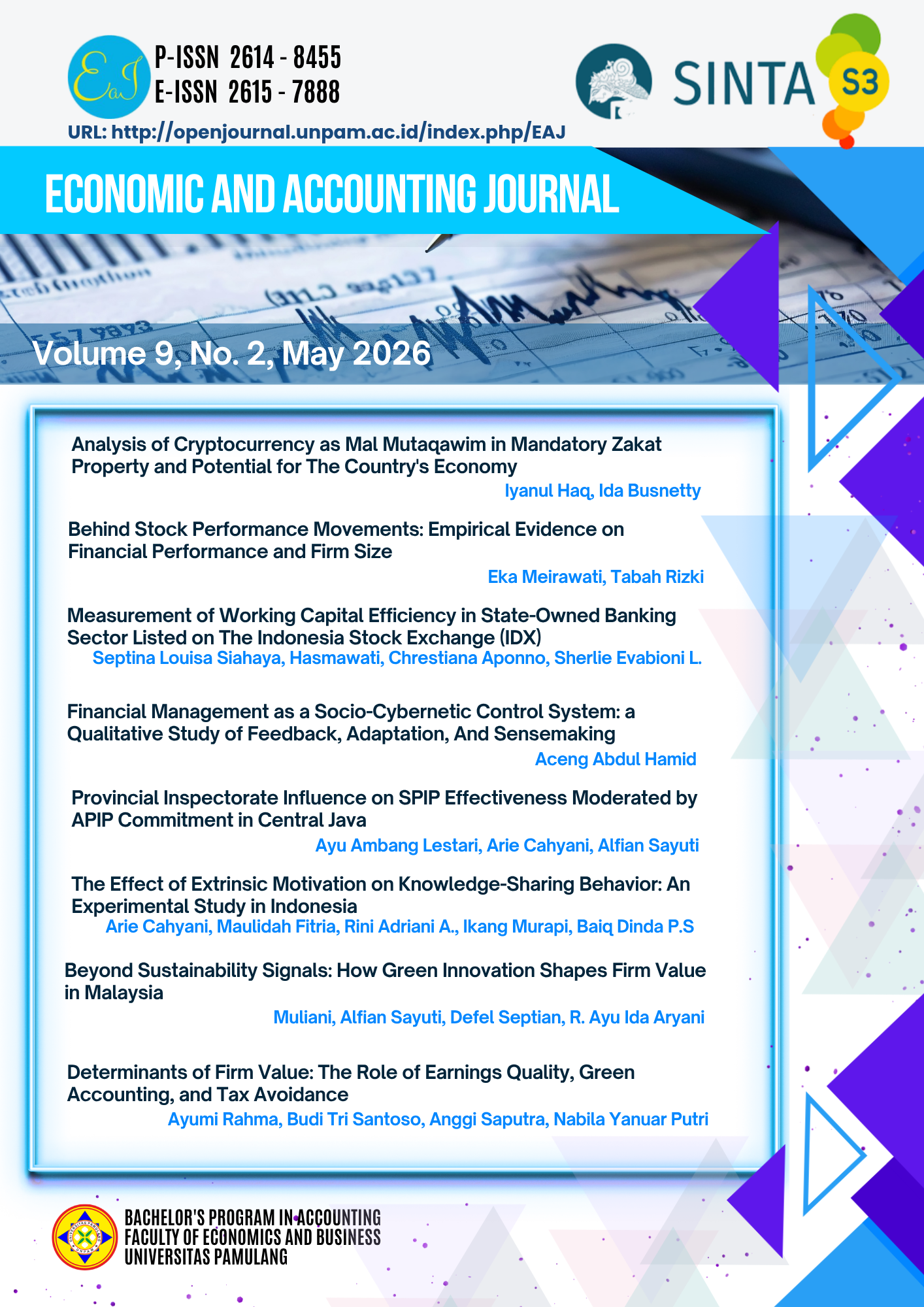
Provincial Inspectorate Influence on SPIP Effectiveness Moderated by APIP Commitment in Central Java
DOI:
https://doi.org/10.32493/eaj.v9i2.y2026.p142-153Keywords:
Government Internal Control System, Internal Government Supervisory Apparatus, Audit Effectiveness, Public Sector AccountabilityAbstract
The purpose of this research is to analyze the role of the Audit Board of Republic Indonesia on the Effectiveness of the Government's Internal Control System. In addition, this study also aims to analyze the commitment of the Internal Government Supervisory Apparatus as a moderating variable to the relationship between the role of the Audit Board of Republic Indonesia on the Effectiveness of the Government Internal Control System. This research was conducted using a survey method by distributing questionnaires to respondents. Respondents in this study are auditors who work in the Provincial and City/ Regency Inspectorates in Central Java. The number of samples used in this study were 244 respondents who worked as auditors in 9 Inspectorates of the city/ regency of Semarang, including the Inspectorate of Provinces of Central Java. The analytical tool used in this study is IBM statistics SPSS v.25. The results showed that the role of Audit Board of Republic Indonesia had a positive effect on the effectiveness of the government's internal control system but the commitment of the government's internal supervisory apparatus could not moderate the relationship between the role of the Audit Board of Republic Indonesia on the effectiveness of the government's internal control system.
References
A, M. N., & Permana, I. (2024). Implementasi Sistem Pengendalian Intern Pemerintah (SPIP) Terintegrasi di Kabupaten. COMSERVA : Jurnal Penelitian Dan Pengabdian Masyarakat, 4(8), 2410–2419. https://doi.org/10.59141/comserva.v4i8.2749
Ashbaugh-Skaife, H., Collins, D., Kinney, W., forthcoming. (2007). The discovery and consequences of internal control deficiencies prior to SOX-mandated audits. Journal of Accounting and Economics.
Atchison, T. J., & Lefferts, E. A. (1972). The prediction of turnover using Herzberg's job satisfaction technique. Personnel Psychology, 1972, 25, 53-64.
BPK RI. (2023). Laporan Hasil Pemeriksaan. https://www.bpk.go.id/laporan_hasil_pemeriksaan
Dewi, M.L.(2025). The Effect of Independence, Objectivity and Experience on Audit Quality. EAJ (Economic and Accounting Journal) – Vol. 8, No. 2.
Fadzil, F., Haron, H., & Jantan, M. (2005), “Internal auditing practices and internal control system”, Managerial Auditing Journal, Vol. 20, No. 8, pp. 844-866.
Fauzia, R., & Susanto, P. (2023). Analisis faktor-faktor yang mempengaruhi pelaksanaan tindak lanjut rekomendasi hasil pemeriksaan BPK pada Kabupaten Pasaman. Jurnal Mirai Management, 8(1), 321–335. https://doi.org/10.37531/mirai.v8i2.5156
Ghozali, Imam. (2016). Aplikasi Analisis Multivariate Program IBM SPSS.
Hamid, M., Kumenaung, A. G., & Maramis, M. T. B. (2022). Pengaruh kompetensi, kompleksitas tugas, time budget pressure dan gaya kepemimpinan terhadap kinerja aparat pengawasan intern pemerintah inspektorat Kota Bitung di masa pandemi covid-19. Jurnal Pembangunan Ekonomi Dan Keuangan Daerah, 23(4), 16–33. https://doi.org/10.35794/jpekd.45000.23.4.2022
Harianja, Simanullang, & R. (2023). Jurnal Ilmu Ekonomi dan Bisnis. Journal of Chemical Information and Modeling, 53(9), 1689–1699. http://repository.upm.ac.id/1199/
Jensen, and W. H. Meckling. (1976). Theory of The Firm: Managerial Behaviour, agency cost and ownership structure. Journal of Financial Economics, vol 3: 305 – 360
Kurniawan, A., Salle, A., & Hafizrianda, Y. (2024). Analisis faktor determinan pelaksanaan tindak lanjut hasil pemeriksaan BPK RI terhadap kinerja Pemerintah Provinsi Papua Barat. Jurnal Kajian Ekonomi & https://doi.org/10.52062/keuda.v9i1.3634
Matondang, K. A., Lubis, Z. H., Fajri, M. Y., Bella, S., & Simanungkalit, B. M. (2025). Peran Sistem Pengendalian Internal dalam Meningkatkan Transparansi dan Akuntabilitas Keuangan di Kota Medan. Journal of Law, Education and Business, 3(1), 466–372. https://doi.org/10.57235/jleb.v3i1.5798
Muhammad, K., & Firmansyah, A. (2024). Bagaimana peran moderasi kepemimpinan dalam pengujian kualitas audit internal pemerintah. Jurnal Akuntansi, Keuangan, Dan Manajemen (JAKMAN), 6(1), 1–16. https://doi.org/10.35912/jakman.v6i1.3500
Permana, K., & Bujana, C. C. A. (2024). Menelaah upaya Aparat Pengawasan Intern Pemerintah (APIP) dalam meningkatkan reformasi birokrasi, integritas, dan manajemen risiko organisasi: Sebuah analisis efisiensi. Integritas : Jurnal Antikorupsi, 10(1), 107 122. https://doi.org/10.32697/integritas.v10i1.1144
Rusak, A. & Johnson, R. (2007). The Responsibilities of Audit Committees, in Jonson, R. (Ed.). Readings in Auditing. John Wiley & Sons Australia Ltd, Milton Qld.
Sawyer B. Lawrence, Ditenhofer A. Mortimer. (2003). Internal Auditing. Fifth Edition, The Institute of Internal Auditors, Florida.
Setyo Widodo, D., & Yandi, A. (2022). Model Kinerja Karyawan: Kompetensi, Kompensasi dan Motivasi, (Literature Review MSDM). Jurnal Ilmu Multidisplin, 1(1), 1–14. https://doi.org/10.38035/jim.v1i1.1
Stephen, J, McNally. 2013. The 2013 COSO Framework & SOC Compliance One Approach to an Efective Transition. The Association of Accountants and Financial Proffesionals in Business.
Zager, Lajos, Sanja, S. Malis., Novak, Ana. (2016). The Role and Responsibility of Auditors in Prevention and Detection of Fraudulent Financial Reporting. Faculty of Economics and Business, Universitty of Zagreb.
Zhang, Yang., Zhou, J., Zhou, N, (2007). Audit Committee Quality, Auditor Independence, and Internal Control Weakness. Journal of Account ing and Public Policy 26, 300-327
Additional Files
Published
Issue
Section
License
Copyright (c) 2026 Milatina Laksmita Dewi, Imtiyaz Farras Mufidah, Maulia Regita Belananda

This work is licensed under a Creative Commons Attribution-ShareAlike 4.0 International License.
Authors who publish with this journal agree to the following terms:
- Authors retain copyright and grant the journal right of first publication with the work simultaneously licensed under a Creative Commons Attribution License that allows others to share the work with an acknowledgement of the work's authorship and initial publication in this journal.
- Authors are able to enter into separate, additional contractual arrangements for the non-exclusive distribution of the journal's published version of the work (e.g., post it to an institutional repository or publish it in a book), with an acknowledgement of its initial publication in this journal.
- Authors are permitted and encouraged to post their work online (e.g., in institutional repositories or on their website) prior to and during the submission process, as it can lead to productive exchanges, as well as earlier and greater citation of published work (See The Effect of Open Access).

This work is licensed under a Creative Commons Attribution-ShareAlike 4.0 International License.
 PUBLICATION ETHICS
 FOCUS AND SCOPE
 EDITORIAL TEAM
 REVIEW PROCESS
 CONTACT US
 AUTHOR GUIDELINES