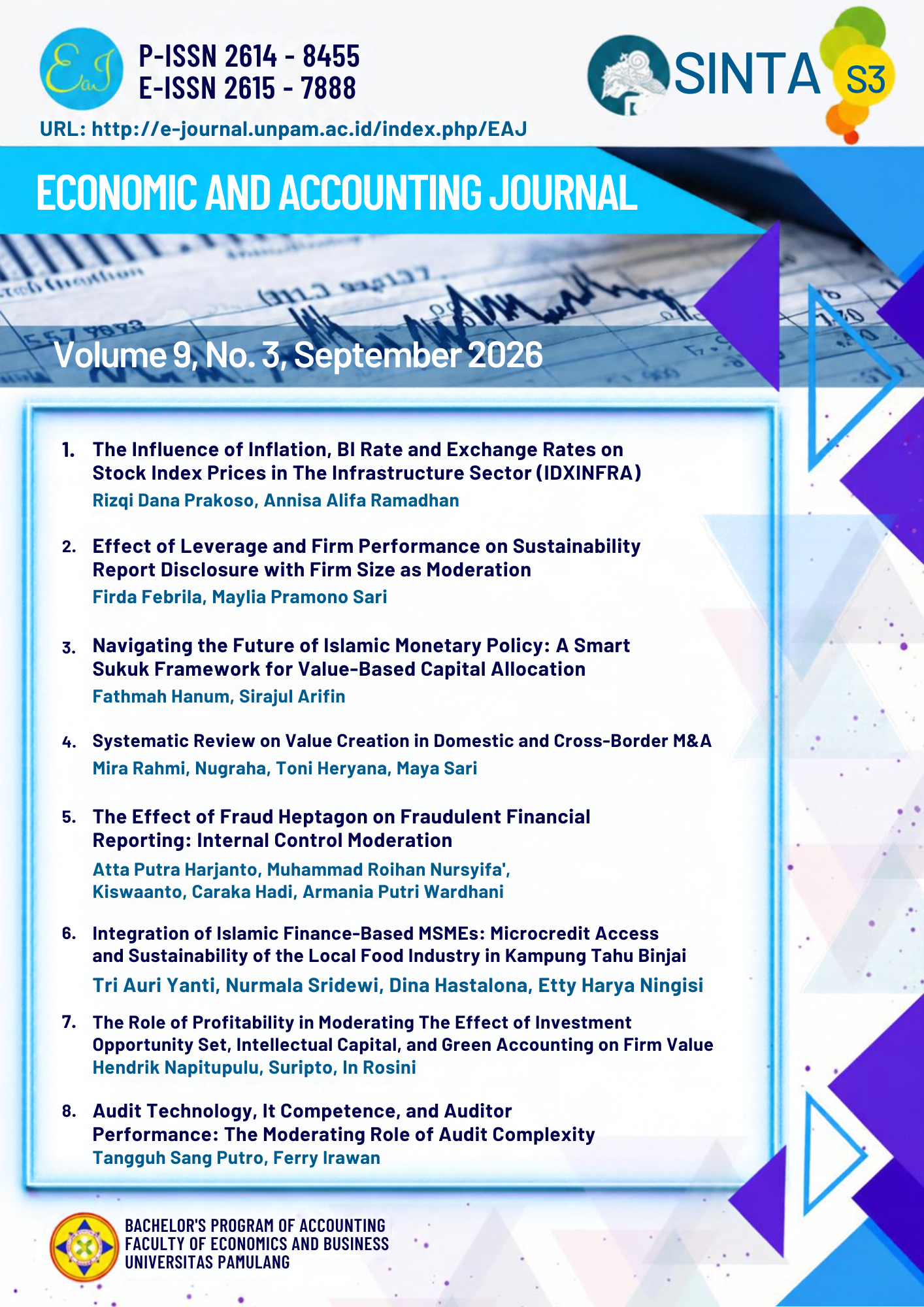
Navigating the Future of Islamic Monetary Policy: A Smart Sukuk Framework for Value-Based Capital Allocation
DOI:
https://doi.org/10.32493/eaj.v9i3.y2026.p217-228Keywords:
smart sukuk, Value-Based Allocation, Islamic Monetary Policy, BlockchainAbstract
The conventional monetary policy framework faces persistent challenges in ensuring that liquidity reaches the productive real sector efficiently and equitably. This study introduces a conceptual framework for Smart Sukuk, blockchain-enabled Islamic monetary instruments that operationalize Value-Based Allocation (VBA) through automated, transparent, and Shariah-compliant capital distribution mechanisms. Employing a qualitative Systematic Literature Review (SLR) methodology and content analysis, this research synthesizes emerging developments in distributed ledger technology (DLT), Islamic monetary policy, and digital sukuk to propose an integrated architecture for central bank operations. The framework demonstrates that Smart Sukuk can substantially reduce transactional friction, enable real-time compliance monitoring, and expand financial inclusion for SMEs and underserved sectors. The findings contribute to the theoretical discourse on Islamic fintech governance and provide actionable policy recommendations for central banks, particularly Bank Indonesia, seeking to develop regulatory sandboxes for blockchain-based monetary instruments. This paper concludes that Smart Sukuk represent not merely a digitalization effort, but a paradigmatic shift toward values-driven monetary policy aligned with maqasid al-Shariah.
References
Ahmed, H., Mohieldin, M., Verbeek, J., & Aboulmagd, F. (2015). On the sustainable development goals and the role of Islamic finance. World Bank Policy Research Working Paper, 7266.
Arner, D. W., Barberis, J., & Buckey, R. P. (2016). FinTech, RegTech, and the reconceptualization of financial regulation. Nw. J. Int’l L. & Bus., 37, 371.
Chapra, M. U. (2008). Ibn Khaldun’s theory of development: Does it help explain the low performance of the present-day Muslim world? The Journal of Socio-Economics, 37(2), 836–863.
Chong, F. H. L. (2021). Enhancing trust through digital Islamic finance and blockchain technology. Qualitative Research in Financial Markets, 13(3), 328–341.
Dusuki, A. W., & Abdullah, N. I. (2007). Maqasid al-Shariah, Maslahah, and corporate social responsibility. American Journal of Islamic Social Sciences, 24(1), 25.
Hassan, M. K., & Aliyu, S. (2018). A contemporary survey of Islamic banking literature. Journal of Financial Stability, 34, 12–43.
Hub, B. I. S. I. (2023). Project mBridge: Experimenting with a multi-CBDC platform for cross-border payments.
IFSB. (2025). Market Developments and lssues. Islamic Financial Services Board.
IIFM. (2025). Sukuk Report 2025: A Comprehensive Study of the Global Sukuk Market. International Islamic Financial Market. https://www.iifm.net/
Iqbal, Z., & Mirakhor, A. (2011). An introduction to Islamic finance: Theory and practice. John Wiley & Sons.
Jegerson, D., Mertzanis, C., & Khan, M. (2025). Emerging trends in Fintech and Islamic finance: acomprehensive review. Journal of Islamic Marketing, 1–31.
Keuangan, O. J. (2023). Roadmap Pengembangan dan Penguatan Perbankan Syariah Indonesia 2023-2027. Departemen Perbankan Syariah. Https://Ojk. Go. Id/Id/Berita-Dan-Kegiatan/Info-Terkini/Documents/Pages/Roadmap-Pengembangan-Dan-Penguatan-Perbankan-Syariah-Indonesia-2023-2027/Roadmap Pengembangan Dan Penguatan Perbankan Syariah Indonesia, 2027.
Krippendorff, K. (2018). Content analysis: An introduction to its methodology. Sage publications.
Malaysia, B. N. (2018). Value-based intermediation: strengthening the roles and impact of Islamic finance. BNM/RH/DP Kuala Lumpur.
Nakamoto, S. (2008). Bitcoin: A peer-to-peer electronic cash system.
Rabbani, M. R., Khan, S., & Thalassinos, E. I. (2020). FinTech, blockchain and Islamic finance: An extensive literature review.
Siddiqi, M. N. (2004). Riba, bank interest and the rationale of its prohibition. Islamic Research and Training Institute Jeddah.
Siti Endang Sariniah, Luthfiah Mianda, Nazrah Athiyah, & Muhammad Faathir Fy. (2025). Pemikiran Ekonomi Abu Yusuf. Journal Economic Excellence Ibnu Sina, 3(2), 269–283. https://doi.org/10.59841/excellence.v3i2.2950
Tranfield, D., Denyer, D., & Smart, P. (2003). Towards a methodology for developing evidence‐informed management knowledge by means of systematic review. British Journal of Management, 14(3), 207–222.
Uddin, M. A., Ali, M. H., & Masih, M. (2017). Political stability and growth: An application of dynamic GMM and quantile regression. Economic Modelling, 64, 610–625.
Vailshery, L. S. (2025). Blockchain – statistics & facts. Statista. https://www.statista.com/topics/5122/blockchain/
WEF. (2025). Asset Tokenization in Financial Markets: The Next Generation of Value Exchange. World Economic Forum. https://www.weforum.org/publications/asset-tokenization-in-financial-markets-the-next-generation-of-value-exchange/
Zulkhibri, M. (2018). The impact of monetary policy on Islamic bank financing: bank-level evidence from Malaysia. Journal of Economics, Finance and Administrative Science, 23(46), 306–322.
Additional Files
Published
Issue
Section
License
Copyright (c) 2026 Fathmah Hanum, Sirajul Arifin

This work is licensed under a Creative Commons Attribution-ShareAlike 4.0 International License.
Authors who publish with this journal agree to the following terms:
- Authors retain copyright and grant the journal right of first publication with the work simultaneously licensed under a Creative Commons Attribution License that allows others to share the work with an acknowledgement of the work's authorship and initial publication in this journal.
- Authors are able to enter into separate, additional contractual arrangements for the non-exclusive distribution of the journal's published version of the work (e.g., post it to an institutional repository or publish it in a book), with an acknowledgement of its initial publication in this journal.
- Authors are permitted and encouraged to post their work online (e.g., in institutional repositories or on their website) prior to and during the submission process, as it can lead to productive exchanges, as well as earlier and greater citation of published work (See The Effect of Open Access).

This work is licensed under a Creative Commons Attribution-ShareAlike 4.0 International License.
 PUBLICATION ETHICS
 FOCUS AND SCOPE
 EDITORIAL TEAM
 REVIEW PROCESS
 CONTACT US
 AUTHOR GUIDELINES