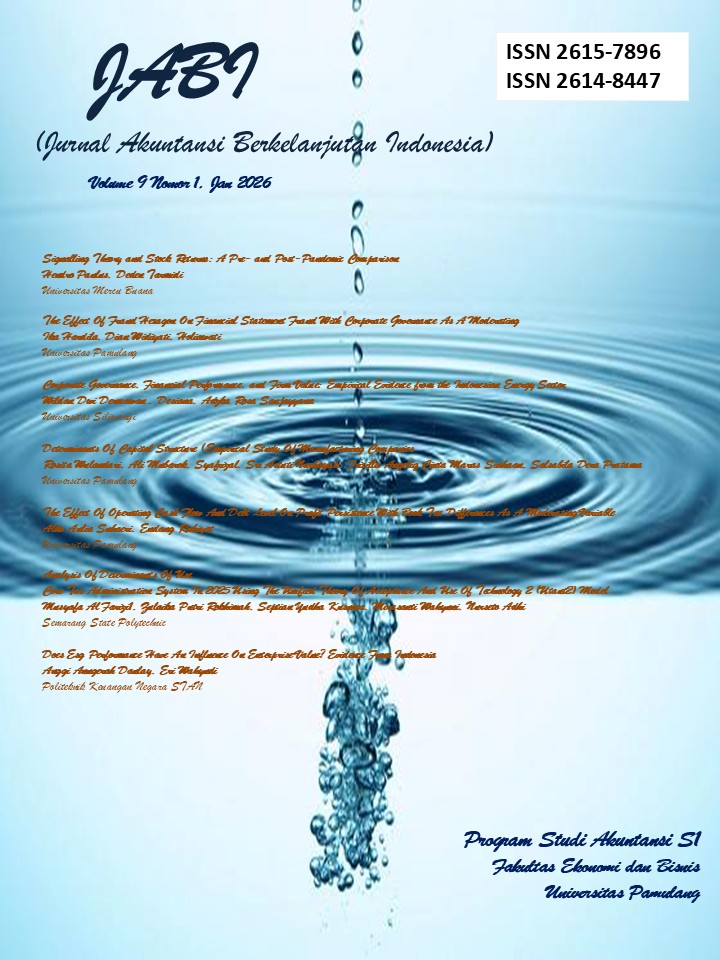
Analysis Of Determinants of Use Core Tax Administration System in 2025 Using the Unified Theory of Acceptance and Use of Technology 2 (Utaut2) Model
DOI:
https://doi.org/10.32493/JABI.v9i1.y2026.p82-99Keywords:
CTAS, UTAUT 2, Taxpayers, Behavioral Intention, Determinant FactorsAbstract
This study aims to analyze the success of the Core Tax Administration System (CTAS) information system from the taxpayer perspective using the UTAUT 2 model. The success of CTAS is crucial; if this tax service system is inadequate for taxpayers, it can reduce the system's adoption rate. The decline in CTAS use by taxpayers will have an impact on decreasing compliance levels, which will ultimately hinder state revenue receipts from the tax sector. The population in this study is the number of companies in Semarang City registered with the Semarang City Department of Industry and Trade (Disperindag) at the end of 2024, namely 845 companies. This study uses the Slovin sampling formula with a 5% error rate, resulting in a sample size of 271 companies. Therefore, the number of samples used in this study was 271 companies in Semarang City. Data were collected using questionnaires distributed to respondents through direct delivery and social media (Google Form). The results showed that Performance Expectancy, Social Influence, and Perceived Security have a positive and significant effect on Behavioral Intention. Furthermore, Facilitating Conditions and Behavioral Intention also had a positive and significant effect on Use Behavior. However, Effort Expectancy, Hedonic Motivation, and Price Value were not found to have a significant effect on Behavioral Intention.
References
Arpaci, I., Yardimci Cetin, Y., & Turetken, O. (2015). Impact of Perceived Security on Organizational Adoption of Smartphones. Cyberpsychology, Behavior, and Social Networking, 18(10), 602–608. https://doi.org/10.1089/cyber.2015.0243
Dianfah, R. A. P., Anggoro, D. D., & Shofwah, A. F. (2024). ANALISIS BEHAVIORAL INTENTION PADA PENERAPAN TAX MONITORING MENGGUNAKAN MODEL UTAUT2. Journal of Tax Policy, Economics, and Accounting, 2(1), 13–28.
Farizi, M. Al, Widiarto, A., Putri, A. G., Kusuma, S. Y., & Sari, M. K. (2020). EVALUATION OF THE SUCCESS OF THE VEHICLE ADMINISTRATION SYSTEM AND ONLINE TAX (SAKPOLE) WITH MODEL DELONE & MCLEAN (Study of success SAKPOLE according to the Central Java provincial Motor vehicle taxpayers). Jurnal Reviu Akuntansi Dan Keuangan, 10(1), 127–135. https://doi.org/10.22219/jrak.v10i1.10955
Fauzi, A., Widodo, T., & Djatmiko, I. T. (2018). Pengaruh Behavioral Intention Terhadap Use Behavioral Pada Penggunaan Aplikasi Transportasi Online. E- Proceeding of Management, 5(2), 1790–1796.
Ghozali, I. (2018). Aplikasi Analisis Multivariate dengan Program IBM SPSS 25. Universitas Diponegoro.
Hermanto, A. H., Windasari, N. A., & Purwanegara, M. S. (2022). Taxpayers’ adoption of online tax return reporting: extended meta-UTAUT model perspective. Cogent Business and Management, 9(1). https://doi.org/10.1080/23311975.2022.2110724
Indrawati, Yuliastri, R., & Amani, H. (2017). Indicators to Measure a Smart Building: An Indonesian Perspective. International Journal of Computer Theory and Engineering, 9(6), 406–411. https://doi.org/10.7763/IJCTE.2017.V9.1176
Kholid, M. N., Alvian, S., & Tumewang, Y. K. (2020). Determinants of Mobile Accounting App Adoption by Micro, Small, and Medium Enterprise in Indonesia. Journal of Accounting and Strategic Finance, 3(1), 52–70. https://doi.org/10.33005/jasf.v3i1.74
Mahendra, Y. A. S., Winarno, W. W., & Santosa, P. I. (2017). Pengaruh Perceived Security terhadap Pengadopsian In-App Purchase pada Aplikasi Mobile. JNTETI, 6(2), 184–193.
Prasetya, I. G. B. I., & Purnamawati, I. G. A. (2020). Pengaruh Nilai Harga, Motivasi Hedonis, Kebiasaan dan Daya Tarik Promo terhadap Minat Menggunakan Mobile Payment OVO. Jurnal Akuntansi Profesi, 11(1), 148–158.
Setiawati, I., Hadiprajitno, P. T. B., & Ardiansah, M. N. (2021). Perspektif Model TAM Dalam Adaptasi Pembelajaran Akuntansi Melalui E-Learning Selama Pandemi COVID-19 Universitas PGRI Semarang. Jurnal Akuntansi Bisnis, 19(1), 36–45.
Venkatesh, V., Thong, J. Y. L., & Xu, X. (2012). CONSUMER ACCEPTANCE AND USE OF INFORMATION TECHNOLOGY: EXTENDING THE UNIFIED THEORY OF ACCEPTANCE AND USE OF TECHNOLOGY. MIS Quarterly, 36(1), 157–178. http://ssrn.com/abstract=2002388
Downloads
Published
Issue
Section
License
Copyright (c) 2026 Musyafa Al Farizi, Zulaika Putri Rokhimah, Septian Yudha Kusuma, Mirasanti Wahyuni, Nurseto Adhi

This work is licensed under a Creative Commons Attribution 4.0 International License.
Authors who publish with this journal agree to the following terms:
- Authors retain copyright and grant the journal right of first publication with the work simultaneously licensed under a Creative Commons Attribution License that allows others to share the work with an acknowledgement of the work's authorship and initial publication in this journal.
- Authors are able to enter into separate, additional contractual arrangements for the non-exclusive distribution of the journal's published version of the work (e.g., post it to an institutional repository or publish it in a book), with an acknowledgement of its initial publication in this journal.
- Authors are permitted and encouraged to post their work online (e.g., in institutional repositories or on their website) prior to and during the submission process, as it can lead to productive exchanges, as well as earlier and greater citation of published work (See The Effect of Open Access)

This work is licensed under a Creative Commons Attribution-ShareAlike 4.0 International License.
 PUBLICATION ETHICS
 FOCUS AND SCOPE
 EDITORIAL TEAM
 CONTACT US
 AUTHOR GUIDELINES