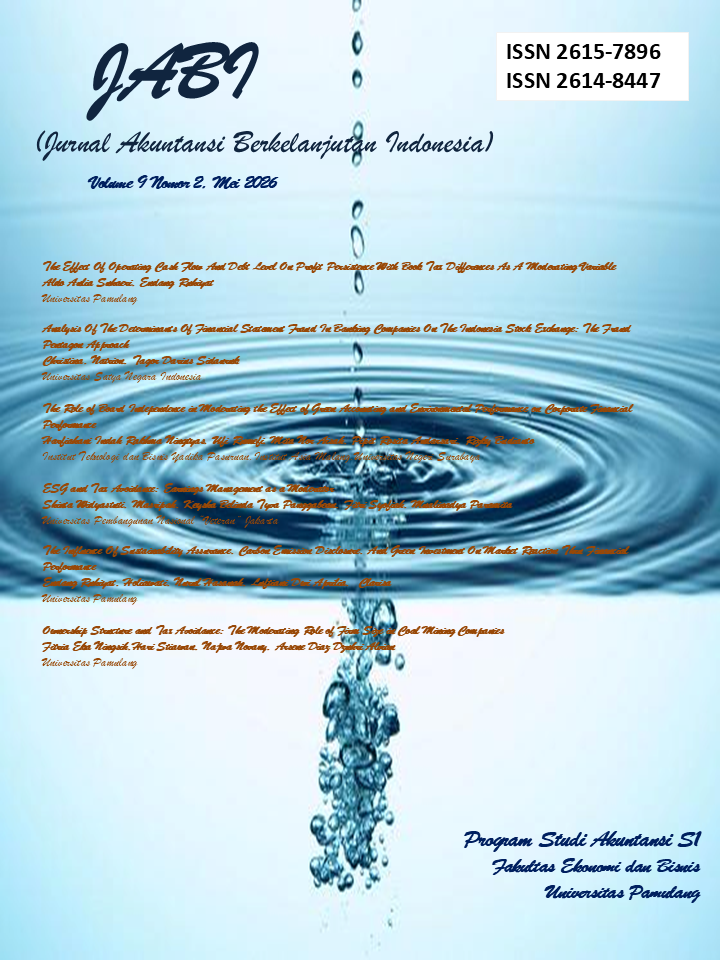
Environmental, Social, Governance (ESG) and Tax Avoidance: The Role of Earnings Management as a Moderator
DOI:
https://doi.org/10.32493/JABI.v9i2.y2026.p193-215Keywords:
ESG, Tax Avoidance, Earnings Management, Reciprocal Impact, Energy SectorAbstract
Environmental, Social, and Governance (ESG) is a practice carried out by companies to disclose non-financial information. This disclosure is expected to provide additional information to investors in making investment decisions. However, tax avoidance and earnings management practices are still carried out by company management, making the relationship between the three interesting to study. This study aims to examine the reciprocal influence between ESG and tax avoidance, and the moderation impact of earnings management. This study is quantitative in nature. The population used is companies in the energy sector, and the sample selection uses purposive sampling techniques. The analysis method using Panel data processing uses Stata version 17. The results obtained are that ESG does not affect tax avoidance, and tax avoidance does not affect ESG. The reciprocal effect between ESG and tax avoidance was not proven for mining sector companies in the 2021-2024 period. Earnings management can weaken the relationship between ESG and tax avoidance, but it cannot moderate the relationship between tax avoidance and ESG. Implications of this result are for regulators to strengthen tax governance and regulation of ESG implementation, and provides insights for knowledge about ESG relationships, tax avoidance, and earnings management.
References
Ajmal, T. K., Kumar, V., & Balasubramanian G. (2025). Tax-avoidance Effect on Investment Inefficiency: An Examination of Agency Theory. Journal of Emerging Market Finance, 24(1), 63–86. https://doi.org/10.1177/09726527241271488
Andrian, Idayanti, I., Hikmah, Y., Saputra, A., Pratama, A. N., & Dzakinah, S. W. (2025). Pengaruh Profitabilitas, Likuiditas dan Struktur Modal Terhadap Nilai Perusahaan. PENG Jurnal Ekonomi Dan Manajemen, 2, 2693–2711. https://doi.org/10.62710/08yyf124
Antonius, F., & Ida, I. (2023). Pengaruh Environmental, Social, Governance (ESG) dan Intellectual Capital Terhadap Kinerja Perusahaan. Jurnal Ekobis: Ekonomi, Bisnis Dan Manajemen, 13(2). http://ejournal.utmj.ac.id/index.php/ekobis126
Arieftiara, D., Masripah, M., & Widyastuti, S. (2025). Corporate Governance And Corporate Culture: The Impact On Tax Avoidance And Corporate Social Responsibility. Serbian Journal of Management, 20(1), 57–80. https://doi.org/10.5937/sjm20-50707
Ariff, A. M., Kamarudin, K. A., Musa, A. Z., & Mohamad, N. A. (2024). Financial constraints, corporate tax avoidance and environmental, social and governance performance. Corporate Governance: The International Journal of Business in Society, 24(7), 1525–1546. https://doi.org/10.1108/CG-08-2023-0343
Cai, C., Hazaea, S. A., Hael, M., Al-Matari, E. M., Alhebri, A., & Alfadhli, A. M. H. (2024). Mapping the Landscape of the Literature on Environmental, Social, Governance Disclosure and Firm Value: A Bibliometric Analysis and Systematic Review. In Sustainability (Switzerland) (Vol. 16, Number 10). Multidisciplinary Digital Publishing Institute (MDPI). https://doi.org/10.3390/su16104239
Carolina, V., Gunawan, Y., & Tedya, R. (2021). Can ESG Performance Moderate The Effect of Tax Avoidance on Corporate Risk? Riset Akuntansi Dan Keuangan Indonesia, 8(1). https://doi.org/http://dx.doi.org/10.23917/reaksi.v8i1.21687
Chang, Y.-J., & Lee, B.-H. (2022). The Impact of ESG Activities on Firm Value: Multi-Level Analysis of Industrial Characteristics. Sustainability, 14(21), 14444. https://doi.org/10.3390/su142114444
Ching, H. Y., & Gerab, F. (2017). Sustainability reports in Brazil through the lens of signaling, legitimacy and stakeholder theories. Social Responsibility Journal, 13(1), 95–110. https://doi.org/10.1108/SRJ-10-2015-0147
Choy, L. Y. (2024). Hong Kong’s changing regulatory approaches to corporate environmental, social, and governance (‘ESG’) disclosure: an evidence-based assessment. Journal of Corporate Law Studies, 24(1), 137–167. https://doi.org/10.1080/14735970.2024.2355678
Cui, X., Li, R., Xue, S., & Zhang, X. (2025). Mandatory versus voluntary: The real effect of ESG disclosures on corporate earnings management. Journal of International Money and Finance, 154. https://doi.org/10.1016/j.jimonfin.2025.103323
Damayanty, P., & Putri, T. R. (2020). The Effect of Corporate Governance on Tax Avoidance by Company Size as the Moderating Variable. 1st International Conference on Sustainable Management and Innovation, 136–151.
Delgado, F. J., Fernández-Rodríguez, E., García-Fernández, R., Landajo, M., & Martínez-Arias, A. (2023a). Tax avoidance and earnings management: a neural network approach for the largest European economies. Financial Innovation, 9(1). https://doi.org/10.1186/s40854-022-00424-8
Delgado, F. J., Fernández-Rodríguez, E., García-Fernández, R., Landajo, M., & Martínez-Arias, A. (2023b). Tax avoidance and earnings management: a neural network approach for the largest European economies. Financial Innovation, 9(1). https://doi.org/10.1186/s40854-022-00424-8
Du, M., & Li, Y. (2023). Tax avoidance, CSR performance and financial impacts: evidence from BRICS economies. International Journal of Emerging Markets. https://doi.org/10.1108/IJOEM-05-2022-0747
Eccles, R. G., Serafeim, G., & Krzus, M. P. (2011). Market Interest in Nonfinancial Information. Journal of Applied Corporate Finance, 23(4), 113–127. https://doi.org/10.1111/j.1745-6622.2011.00357.x
Elamer, A. A., Boulhaga, M., & Ibrahim, B. A. (2024). Corporate tax avoidance and firm value: The moderating role of environmental, social, and governance (ESG) ratings. Business Strategy and the Environment, 33(7), 7446–7461. https://doi.org/10.1002/bse.3881
Elgharbawy, A., & Aladwey, L. M. A. (2025). ESG performance, board diversity and tax avoidance: empirical evidence from the UK. Journal of Financial Reporting and Accounting. https://doi.org/10.1108/JFRA-04-2024-0177
Firmansyah, A., Darmastuti, D., Nugraheni, R., & Swatdikun, T. (2026). The effect of ESG performance on tax avoidance: the moderating role of earnings management in ASEAN firms. Cogent Business and Management, 13(1). https://doi.org/10.1080/23311975.2026.2635798
Gupta, J., Kushwaha, N. N., Li, X., & Ebrahimi, T. (2025). Does firm-level political risk influence earnings management? Review of Quantitative Finance and Accounting, 64(3), 1165–1198. https://doi.org/10.1007/s11156-024-01330-z
Hanlon, M., & Heitzman, S. (2010). A review of tax research. Journal of Accounting and Economics, 50(2–3), 127–178. https://doi.org/10.1016/j.jacceco.2010.09.002
Hashmi, S. D., Gulzar, S., Ghafoor, Z., & Naz, I. (2020). Sensitivity of Firm Size Measures to Practices of Corporate Finance: Evidence From BRICS. Future Business Journal, 6(1). https://doi.org/10.1186/s43093-020-00015-y
Hidayat, K., & Zuhroh, D. (2023). The Impact of Environmental, Social and Governance, Sustainable Financial Performance, Ownership Structure, and Composition of Company Directors on Tax Avoidance: Evidence from Indonesia. International Journal of Energy Economics and Policy, 13(6), 311–320. https://doi.org/10.32479/ijeep.14557
Hien, H. T., Thanh, L.-V., Phi, S.-N., & Le, T.-A. (2025). Bibliometric analysis of corporate social responsibility and tax avoidance. Discover Sustainability. https://doi.org/10.1007/s43621-025-02420-1
Itan, I., Ahmad, Z., Setiana, J., & Karjantoro, H. (2024). Corporate governance, tax avoidance and earnings management: family CEO vs non-family CEO managed companies in Indonesia. Cogent Business and Management, 11(1). https://doi.org/10.1080/23311975.2024.2312972
Jensen, M. C., & Meckling, W. H. (1979). Theory of the Firm: Managerial Behavior, Agency Costs, and Ownership Structure (pp. 163–231). https://doi.org/10.1007/978-94-009-9257-3_8
Jiang, H., Hu, W., & Jiang, P. (2024). Does ESG performance affect corporate tax avoidance? Evidence from China. Finance Research Letters, 61. https://doi.org/https://doi.org/10.1016/j.frl.2024.105056
Johanes Simamora, A. (2019). Earnings Management and Future Earnings. Jurnal Akuntansi Dan Keuangan Indonesia, 16(2), 141–164. https://doi.org/10.21002/jaki.2019.08
Journeault, M., Levant, Y., & Picard, C. F. (2021). Sustainability performance reporting: A technocratic shadowing and silencing. Critical Perspectives on Accounting, 74. https://doi.org/10.1016/j.cpa.2019.102145
Kartika, A., Janah, A., & Hardiyanti, W. (2023). Deteksi Manajemen Laba: Perencanaan Pajak, Beban Pajak Tangguhan, Aset Pajak Tangguhan, Kepemilikan Manajerial dan Free Cash Flow (Studi Empiris Perusahaan Manufaktur di Indonesia). ECONBANK: Journal of Economics and Banking, 5(1), 51–63. https://doi.org/10.35829/econbank.v5i1.260
Khairin, M. Y., & Firmansyah, A. (2025). The ESG-tax avoidance nexus in SOEs: Do investment, strategy, and political ties matter. Journal of Accounting and Investment, 26(1), 87–109. https://doi.org/10.18196/jai.v26i1.23638
Khamisan, M. S. P., & Christina, S. (2020). Financial Distress, Tax Loss Carried Forward, Corporate Governance and Tax Avoidance. GATR Accounting and Finance Review, 5(3), 87–94. https://doi.org/10.35609/afr.2020.5.3(1)
Kovermann, J., & Velte, P. (2019). The impact of corporate governance on corporate tax avoidance—A literature review. Journal of International Accounting, Auditing and Taxation, 36. https://doi.org/10.1016/j.intaccaudtax.2019.100270
Kovermann, J., & Velte, P. (2021). CSR and tax avoidance: A review of empirical research. Corporate Ownership and Control, 18(2), 20–39. https://doi.org/10.22495/cocv18i2art2
Lin, C.-Y., Chau, K. Y., Tran, T. K., Sadiq, M., Van, L., & Hien Phan, T. T. (2022). Development of renewable energy resources by green finance, volatility and risk: Empirical evidence from China. Renewable Energy, 201, 821–831. https://doi.org/10.1016/j.renene.2022.10.086
Lin, K. Z., Cheng, S., & Zhang, F. (2017). Corporate Social Responsibility, Institutional Environments, and Tax Avoidance: Evidence from a Subnational Comparison in China. International Journal of Accounting, 52(4), 303–318. https://doi.org/10.1016/j.intacc.2017.11.002
Liu, H., & Lee, H. A. (2019). The effect of corporate social responsibility on earnings management and tax avoidance in Chinese listed companies. International Journal of Accounting and Information Management, 27(4), 632–652. https://doi.org/10.1108/IJAIM-08-2018-0095
Mao, Z., Wang, S., & Lin, Y. (2024). ESG, ESG rating divergence and earnings management: Evidence from China. Corporate Social Responsibility and Environmental Management, 31(4), 3328–3347.
Melinda, A., & Wardhani, R. (2020). The Effect Of Environmental, Social, Governance, And Controversies On Firms’ Value: Evidence From Asia. In International Symposia in Economic Theory and Econometrics (Vol. 27, pp. 147–173). Emerald Publishing. https://doi.org/10.1108/S1571-038620200000027011
Meyer, A. K., & Dutzi, A. (2024). What Earnings Management Has to Do with Corporate Social Responsibility. In Sustainability (Switzerland) (Vol. 16, Number 7). Multidisciplinary Digital Publishing Institute (MDPI). https://doi.org/10.3390/su16072836
Minor, D., & Morgan, J. (2011). CSR as Reputation Insurance: Primun Non Nocere. California Management Review, 53(3).
Montenegro, T. M. (2021). Tax evasion, corporate social responsibility and national governance: a country-level study. Sustainability (Switzerland), 13(20). https://doi.org/10.3390/su132011166
Mustapha, M. Z., Zakaria, Z., Rahin, N. M., & Wahab, N. S. A. (2023). Competitive Strategies for Corporate Sustainability. Foresight and STI Governance, 17(4), 45–53. https://doi.org/10.17323/2500-2597.2023.4.45.53
Nawaz, M. A., Seshadri, U., Kumar, P., Aqdas, R., Patwary, A. K., & Riaz, M. (2021). Nexus between green finance and climate change mitigation in N-11 and BRICS countries: empirical estimation through difference in differences (DID) approach. Environmental Science and Pollution Research, 28(6), 6504–6519. https://doi.org/10.1007/s11356-020-10920-y
Ningsih, S. (2015). Earning Management Melalui Aktivitas Riil Dan Akrual. Jurnal Akuntansi Dan Pajak, 16(1).
Nurafifah, N., Vinneza, S., Utha, M. A., Kurniawati, K., Hermawan, A., & Mihály, A. (2025). Implementasi ESG dan Kinerja Keuangan: Wawasan dari Perusahaan Multi Sektor di Indonesia enter 1 x enter 1 x. JAFM: Journal of Accounting and Finance Management, 5(4). https://doi.org/10.38035/jafm.v6i4
Oktavia, V., Jefri, U., & Kusuma, J. W. (2021). Pengaruh Good Corporate Governance dan Ukuran Perusahaan Terhadap Tax Avoidance (Pada Perusahaan properti dan Real Estate yang Terdaftar di BEI Periode 2015-2018). Jurnal Revenue, 01(02). https://doi.org/10.46306/rev.v1i2
Pratiwi, I. S., & Djakman, C. D. (2017). The Role of Corporate Political Connections in the Relation of CSR and Tax Avoidance: Evidence from Indonesia. Review of Integrative Business and Economics Research, 6(1). http://buscompress.com/journal-home.html
Putri, C. A. (2023, May 2). Duh! Jumlah Perusahaan yang Lapor SPT Tak Sampai 1 Juta. https://www.cnbcindonesia.com/news/20230502172129-4-433823/duh-jumlah-perusahaan-yang-lapor-spt-tak-sampai-1-juta
Rahman, R. A., & Alsayegh, M. F. (2021). Determinants of Corporate Environment, Social and Governance (ESG) Reporting among Asian Firms. Journal of Risk and Financial Management, 14(4). https://doi.org/10.3390/jrfm14040167
Scott, W. R. (2015). Financial Accounting Theory . Pearson.
Septanta, R. (2023). Pengaruh Kepemilikan Institusional, Kepemilikan Manajerial, dan Kompensasi Rugi Fiskal terhadap Penghindaran Pajak. Scientific Journal Of Reflection : Economic, Accounting, Management and Business, 6(1), 95–104. https://doi.org/10.37481/sjr.v6i1.623
Sibuea, D. P., & Afriani, C. (2025). Linking ESG to Tax Avoidance: Do Women Directors Matter? International Journal of Business Studies, 9(2), 162.
Smulowitz, S., Becerra, M., & Mayo, M. (2019). Racial diversity and its asymmetry within and across hierarchical levels: The effects on financial performance. Human Relations, 72(10), 1671–1696. https://doi.org/10.1177/0018726718812602
Sofia, A. (2024, April 24). Mengenal Konsep ESG: Pilar Penting Menuju Bisnis Berkelanjutan. https://Sparse.Feb.Ugm.Ac.Id/Mengenal-Konsep-Esg-Pilar-Penting-Menuju-Bisnis-Berkelanjutan/.
Sofiya, H. (2019). Earnings management to tax avoidance. Journal of Management Applications and Business Innovation, 6(1), 5–10.
Suchman, M. C. (1995). Managing Legitimacy: Strategic and Institutional Approaches. The Academy of Management Review, 20(3), 571. https://doi.org/10.2307/258788
Velte, P. (2023). Determinants and financial consequences of environmental performance and reporting: A literature review of European archival research. In Journal of Environmental Management (Vol. 340). Academic Press. https://doi.org/10.1016/j.jenvman.2023.117916
Velte, P. (2025). Corporate Social Responsibility Decoupling and Tax Avoidance: Symbolic Use of Sustainable Boards in the European Union? Corporate Social Responsibility and Environmental Management, 32(3), 4179–4193. https://doi.org/10.1002/csr.3172
Weisbach, D. A. (2002). An Economic Analysis of Anti-Tax-Avoidance Doctrines. American Law and Economics Association, 4(1), 88–115. https://doi.org/10.1093/aler/4.1.88
Widyastuti, S., Masripah, & Arieftiara, D. (2024). Comparative Study of Corporate Governance and Culture in Indonesia and Malaysia: The Effect on Tax Avoidance and Corporate Social Responsibility. Global Business and Finance Review, 29(9), 14–28. https://doi.org/10.17549/gbfr.2024.29.9.14
Yanto, H., Hajawiyah, A., & Baroroh, N. (2025). The reciprocal effect of environmental, social, and governance (ESG) practices and tax aggressiveness in Indonesian and Malaysian companies. Problems and Perspectives in Management, 23(1), 339–351. https://doi.org/10.21511/ppm.23(1).2025.25
Yoon, B. H., Lee, J. H., & Cho, J. H. (2021). The effect of esg performance on tax avoidance—evidence from korea. Sustainability (Switzerland), 13(12). https://doi.org/10.3390/su13126729
Yorke, S. M., Amidu, M., & Agyemin-Boateng, C. (2016). Journal of Risk Finance, Investment Management and Financial Innovations. In Journal of Africa Business and Baltic Journal of Management, 9(2).
Yuliana, N. A., Nuryati, T., Rossa, E., & Machdar, N. M. (2023). Pengaruh Perencanaan Pajak, Beban Pajak Tangguhan, dan Penghindaran Pajak Terhadap Manajemen Laba. SINOMIKA Journal: Publikasi Ilmiah Bidang Ekonomi Dan Akuntansi, 2(1), 55–64. https://doi.org/10.54443/sinomika.v2i1.986
Yusnita, H. (2023). The Effect of Corporate Social Responsibility on Tax Avoidance: The Moderating Role of Earnings Management. International Journal of Business and Social Science Research, 4(10). https://doi.org/http://dx.doi.org/10.47742/ijbssr.v4n10p
Downloads
Published
Issue
Section
License
Copyright (c) 2026 Shinta Widyastuti, Masripah Masripah, Keysha Belynda Tyva panggabean, Fitri Syofiah, Mualinadya Paramita

This work is licensed under a Creative Commons Attribution 4.0 International License.
Authors who publish with this journal agree to the following terms:
- Authors retain copyright and grant the journal right of first publication with the work simultaneously licensed under a Creative Commons Attribution License that allows others to share the work with an acknowledgement of the work's authorship and initial publication in this journal.
- Authors are able to enter into separate, additional contractual arrangements for the non-exclusive distribution of the journal's published version of the work (e.g., post it to an institutional repository or publish it in a book), with an acknowledgement of its initial publication in this journal.
- Authors are permitted and encouraged to post their work online (e.g., in institutional repositories or on their website) prior to and during the submission process, as it can lead to productive exchanges, as well as earlier and greater citation of published work (See The Effect of Open Access)

This work is licensed under a Creative Commons Attribution-ShareAlike 4.0 International License.
 PUBLICATION ETHICS
 FOCUS AND SCOPE
 EDITORIAL TEAM
 CONTACT US
 AUTHOR GUIDELINES