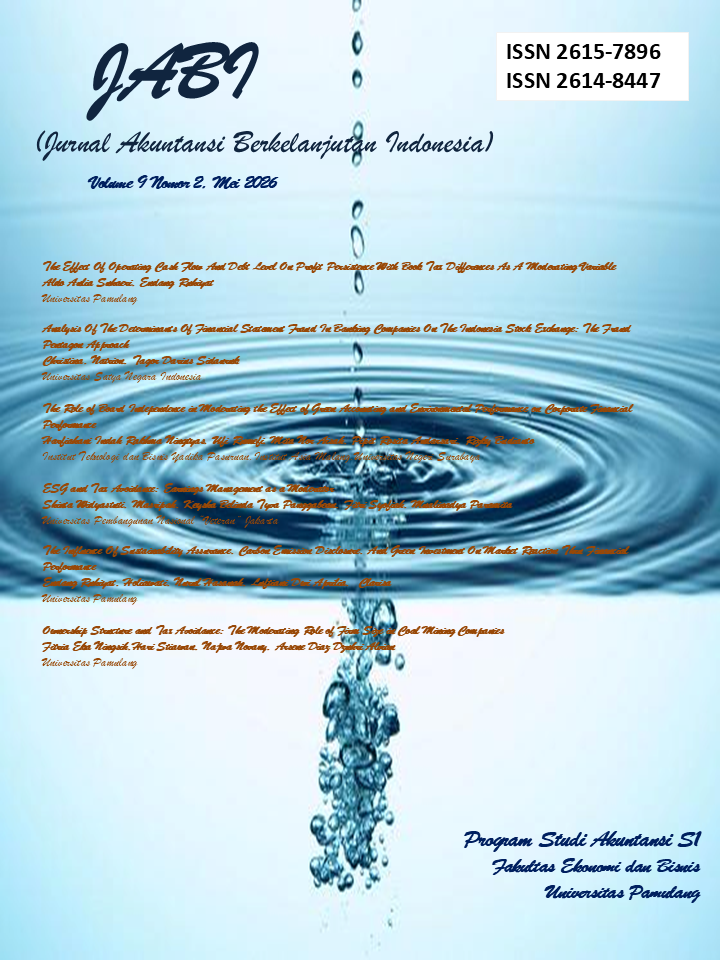
Analysis Of The Determinants Of Financial Statement Fraud In Banking Companies On The Indonesia Stock Exchange: The Fraud Pentagon Approach
DOI:
https://doi.org/10.32493/JABI.v9i2.y2026.p155-172Keywords:
Financial stability, External pressure, Nature of industry, Ineffective monitoring, Change in auditor, Total accrual ratio, Capability, Financial statement fraudAbstract
This study aims to analyze financial stability, external pressure, the nature of the industry, ineffective monitoring, changes in auditors, the total accrual ratio, and capability as factors that motivate financial statement fraud. This study focuses on banking companies because the banking sector is synonymous with cases of financial statement fraud and tends to have a high conflict of interest. The study sample consisted of 23 banking companies for the period 2021–2025, totaling 115 observations. The results of this study indicate that the total accrual ratio variable has a positive effect on motivating financial statement fraud. The external pressure variable has a negative effect on motivating financial statement fraud. This study does not prove that financial stability, the nature of the industry, ineffective monitoring, changes in auditors, and capability have an influence on motivating financial statement fraud
References
Abhimanyu, F. Z. (2021). Faktor – Faktor Yang Mempengaruhi Kecurangan Laporan Keuangan Dalam Perspektif Fraud Triangle. In Jurnal Akuntansi, Keuangan, dan Manajemen (Vol. 4, Issue 1). https://doi.org/10.35912/jakman.v4i1.1677
ACFE. (2024). Occupational Fraud 2024: A Report to the Nations. Association of Certified Fraud Examiners, Inc.
Azizah, L., Ridwansyah, E., & Kurniawan, U. (2025). Faktor-Faktor Yang Berpengaruh Terhadap Kecurangan Laporan Keuangan Dengan Menggunakan Analisis Fraud Hexagon. Jurnal Revenue, Jurnal Akuntansi, 5 (10.46306/rev.v5i2), 1982-1994. https://doi.org/10.46306/rev.v5i2.770
Bell, T. B., S. S. J. Skousen, dan J. F. P. 1991. Perspectives on Auditing: A Collection of Papers.
Christina, & Afraini, F. H. (2024). Determinasi Psikologis Auditor Terhadap Pertimbangan Profesional Auditor. Jurnal Akuntansi Keuangan Dan Bisnis, 18 (1), 45-54. https://jurnal.pcr.ac.id/index.php/jakb/article/view/6432
Christina, Dewi, I. S., & Khoirunnisa, V. (2025). Investigasi Karakteristik Personal Auditor dalam Pendeteksian Kecurangan dengan Moderasi Tekanan Waktu. Jurnal Akuntansi Berkelanjutan Indonesia, 8 (2), 222-239. https://openjournal.unpam.ac.id/index.php/JABI/article/view/49150/23968
Christina, Ilyas, M., & Salsabila, P. (2025). Determinan Ketepatan Pemberian Opini Audit Dengan Pengalaman Auditor Sebagai Variabel Moderasi. Jurnal Ilmiah Akuntansi Dan Ekonomi, 10 (1), 1-9. https://ojs.jekobis.org/index.php/liabilitas/article/view/468/375.
Cressey, D. R. (1953). Other People's Money: A Study in the Social Psychology of Embezzlement. Glencoe, IL: Free Press
Darise, R. F., Kalangi, L., & Gamaliel, H. (2021). Faktor-Faktor Yang Memengaruhi Fraudulent Financial Statement Studi Empiris Pada Perusahaan Sektor Perbankan Yang Terdaftar Di Bursa Efek Indonesia. In Jurnal Riset Akuntansi dan Auditing “Goodwill” (Vol. 12, Issue 2).
Dewi, I. S. (2021). Kecurangan Laporan Keuangan Dalam Perspektif Fraud Triangle. Jurnal Ilmiah Akuntansi Dan Ekonomi, 6(2), 16–27.
Ghozali, I. (2021). Aplikasi Analisis Multivariate Dengan Program IBM SPSS 26. Badan Penerbit Universitas Diponegoro.
Handayani, C. (2022). Analisis Pengaruh Fraud Diamond Dan Capital Turnover Dalam Mendeteksi Kecurangan Laporan Keuangan.
Herianti, E., Suryani, A., & Marundha, A. (2023). Audit Kecurangan Laporan Keuangan. Eureka Media Aksara.
IAPI. (2013). Standar Profesional Akuntan Publik (SPAP): Standar Audit (SA) 240. Salemba Empat.
Jensen, M. C., & Meckling, W. H. (1976). Theory of the firm: Managerial behavior, agency costs and ownership structure. Journal of Financial Economics, 3(4), 305-360.
Loebbecke, J. K., Eining, M. M., & Willingham, J. J. (1989). Auditors' Experience with Material Irregularities: Frequency, Nature, and Detectability. Auditing: A Journal of Practice & Theory, 9(Fall), 1-28.
Muawanah, P. M. (2024). Fenomena Skandal Kejahatan Akuntansi di Indonesia. Kompasiana.com
Nuraya, A. S., & Fachriyaho, N. (2024). Faktor-Faktor Yang Memengaruhi Financial Statement Fraud. Studi Akuntansi Dan Keuangan Indonesia, 7(No. 2), 187–200.
Octaviana, N. (2022). Analisis Elemen-Elemen Fraud Hexagon Theory Sebagai Determinan Fraudulent Financial Reporting. Jurnal Akuntansi, 11(2), 106–121. https://doi.org/10.46806/ja.v11i2.895
Putri, A. C., & Suhartono, S. S. (2023). Kemampuan Kualitas Audit Memoderasi Pengaruh Fraud Hexagon Terhadap Fraudulent Financial Statements. Jurnal Bina Akuntansi, 10(2), 732-757.
Ratnasari, M. dan, & Rofi, M. A. (2020). Faktor-Faktor Yang Memotivasi Kecurangan Laporan Keuangan. www.bpk.go.id.
Sugiyono. (2023). Metode Penelitian Kuantitatif, Kualitatif, Dan R&D. Alfabeta, cv. www.cvalfabeta.com
Sulaiimah, A. R., Meidiyustiani, R., Anwar, S., & Safitra Hidayat, R. (2022). Analisis Pengaruh Fraud Diamond Terhadap Fraudulent Financial Statement. Jurnal Sinar Manajemen, 09(03).
Warisi, D. dan R. K. (2024). Pengaruh Rasio Likuiditas, Solvabilitas, dan Efisiensi terhadap Kinerja Keuangan Perbankan Konvensional Periode 2019-2022. Jurnal Penelitian Ekonomi Manajemen Dan Bisnis, 3(2), 28–39. https://doi.org/10.55606/jekombis.v3i2.3470.
Wolfe, D. T., & Hermanson, D. R. (2004). The Fraud Diamond: Considering the Four Elements of Fraud. The CPA Journal, 74(12), 38-42.
Downloads
Published
Issue
Section
License
Copyright (c) 2026 Christina Christina, Natrion Natrion, Tagor Darius Sidauruk

This work is licensed under a Creative Commons Attribution 4.0 International License.
Authors who publish with this journal agree to the following terms:
- Authors retain copyright and grant the journal right of first publication with the work simultaneously licensed under a Creative Commons Attribution License that allows others to share the work with an acknowledgement of the work's authorship and initial publication in this journal.
- Authors are able to enter into separate, additional contractual arrangements for the non-exclusive distribution of the journal's published version of the work (e.g., post it to an institutional repository or publish it in a book), with an acknowledgement of its initial publication in this journal.
- Authors are permitted and encouraged to post their work online (e.g., in institutional repositories or on their website) prior to and during the submission process, as it can lead to productive exchanges, as well as earlier and greater citation of published work (See The Effect of Open Access)

This work is licensed under a Creative Commons Attribution-ShareAlike 4.0 International License.
 PUBLICATION ETHICS
 FOCUS AND SCOPE
 EDITORIAL TEAM
 CONTACT US
 AUTHOR GUIDELINES