
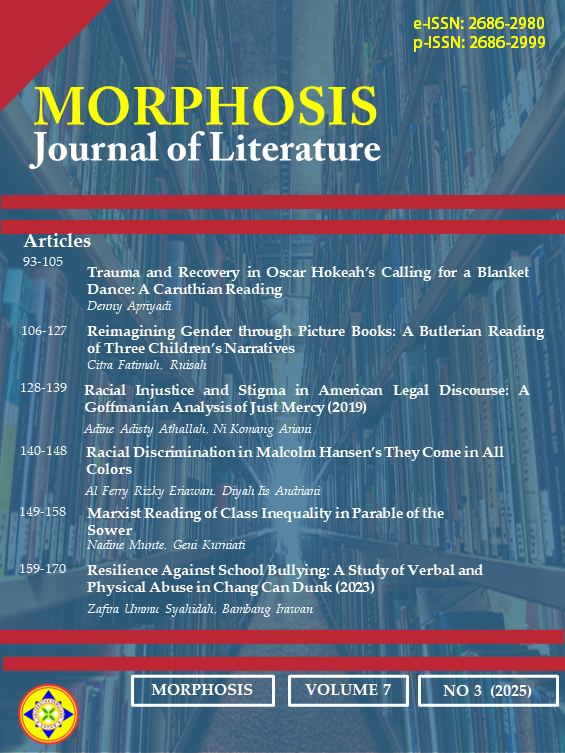
Trauma and Recovery in Oscar Hokeah’s Calling for a Blanket Dance: A Caruthian Reading
DOI:
https://doi.org/10.0234/mps.v7i3.52410Keywords:
avoidance, recovery, symptoms, storytelling, traumatic experiencesAbstract
This study aims to examine the traumatic experiences and recovery process of the main character in Calling for a Blanket Dance (2023) by Oscar Hokeah. The novel follows Ever Geimausaddle, a Native American protagonist, as he navigates cycles of pain, resilience, and eventual healing. Through a multi-perspective narrative structure, Ever’s life is shaped by repeated encounters with trauma, rooted in both personal and cultural histories. This research employs a qualitative approach with a descriptive method to analyze narrative and dialogic elements from the novel. Drawing on Cathy Caruth’s (1996) trauma theory, the study investigates how trauma is represented and processed throughout the text. The findings reveal that Ever’s experiences align with four key symptoms of trauma: flashbacks, nightmares, intrusive thoughts, and avoidance. These symptoms manifest across various stages of his life, affecting his psychological state and interpersonal relationships. Furthermore, the study identifies several pathways to recovery portrayed in the novel, including the role of community support, reconnection with family, and the healing potential of storytelling. These coping mechanisms are central to Ever’s gradual healing and highlight the importance of culturally rooted resilience. Ultimately, the novel illustrates not only the enduring impact of trauma but also the transformative potential of collective healing and narrative expression. This research contributes to literary trauma studies by offering insight into Indigenous trauma narratives and the culturally embedded practices that foster recovery.
References
Amigoni, D. (2022). The english novel and prose narrative. Edinburgh University Press.
Anderson, A., Felski, R., & Moi, T. (2019). Character: Three inquiries in literary studies. University Of Chicago Press. https://doi.org/https://doi.org/10.1080/0013838X.2021.1924962
Bassett, D., Buchwald, D., & Manson, S. (2014). Posttraumatic stress disorder and symptoms among American Indians and Alaska natives: A review of the literature. Social Psychiatry and Psychiatric Epidemiology, 49(3), 417–433. https://doi.org/10.1007/s00127-013-0759-y
Bateman, A. W., Holmes, J., & Allison, E. (2021). Introduction to psychoanalysis. In Introduction to Psychoanalysis. Routledge. https://doi.org/10.4324/9780429355110
Bennett, A., & Royle, N. (2023). An introduction to literature, criticism and theory. Routledge.
Caruth, C. P. (1996). Unclaimed experience: Trauma, narrative and history. The Johns Hopkins University Press.
Craig, C. (2018). John Trudell and the spirit of life. Workplace: A Journal for Academic Labor, 30, 394–404.
Dancyger, K. (2019). Storytelling for film and television. Routledge.
Daverne, C., & Wittorski, R. (2022). Research methodology in education and training (1st ed.). Wiley-ISTE.
Elkins, K. (2022). The shapes of stories. In The Shapes of Stories. Cambridge University Press. https://doi.org/10.1017/9781009270403
Hokeah, O. (2023). Calling for a blanket dance. Algonquin Books.
National Institute of Justice. (2023). Five things about violence against American Indian and Alaska Native women and men. U.S. Department of Justice, Office of Justice Programs. https://nij.ojp.gov
Khotimah, K., Churil, F., Aini, K., Indah, W., & Rohmana, M. (2023). Traumatic experience in the novel The Perks of Being a Wallflower : Individual psychology. Journal of English Language Education and Literature, 8(1), 5–10.
Kiosses, S. (2021). Plot theory and creative writing: Manipulating readers’ desire and expectation. International Journal of Education and Social Science Research, 04(04), 265–281. https://doi.org/10.37500/ijessr.2021.4417
Lim, W. M. (2024). What is qualitative research? An overview and guidelines. Australasian Marketing Journal. https://doi.org/10.1177/14413582241264619
Luthfiandana, R., Santioso, L. L., Febrian, W. D., & Soehaditama, J. P. (2024). Qualitative research concepts: Phenomenology, grounded theory, ethnography, case study, narrative. Siber Journal of Advanced Multidisciplinary, 2(1), 26–36. https://doi.org/https://doi.org/10.38035/sjam.
Meraz, R. L., Osteen, K., & McGee, J. (2019). Applying multiple methods of systematic evaluation in narrative analysis for greater validity and deeper meaning. International Journal of Qualitative Methods, 18. https://doi.org/10.1177/1609406919892472
Meretoja, & Hanna. (2017). The ethics of storytelling: Narrative hermeneutics, history, and the possible. Oxford University Press.
Phelan, J. (2017). Somebody telling somebody else: A rhetorical poetics of narrative. Ohio State University Press.
Sareen, J. (2014). Posttraumatic stress disorder in adults: Impact, comorbidity, risk factors, and treatment. CanJPsychiatry, The Canadian Journal of Psychiatry, 59(9), 460–467. www.TheCJP.ca
Sartika, E. (2020). Traumatic experiences in Eka Kurniawan’s novel Seperti Dendam, Rindu Harus Dibayar Tuntas. Jurnal Ilmu Sastra, 8(2). https://doi.org/10.22146/poetika.55895
Tiansyah, R. N., Suharyati, H., & Ratih, S. D. (2021). The impact of psychological trauma on the life of the main character in the novel Eleanor Oliphant is Completely Fine. Journal Albion: Journal of English Literature, Language, and Culture, 3(1), 31–36. http://journal.unpak.ac.id/index.php/albion
Downloads
Published
How to Cite
Issue
Section
License
Copyright (c) 2025 Denny Apriyadi

This work is licensed under a Creative Commons Attribution-NonCommercial-ShareAlike 4.0 International License.


