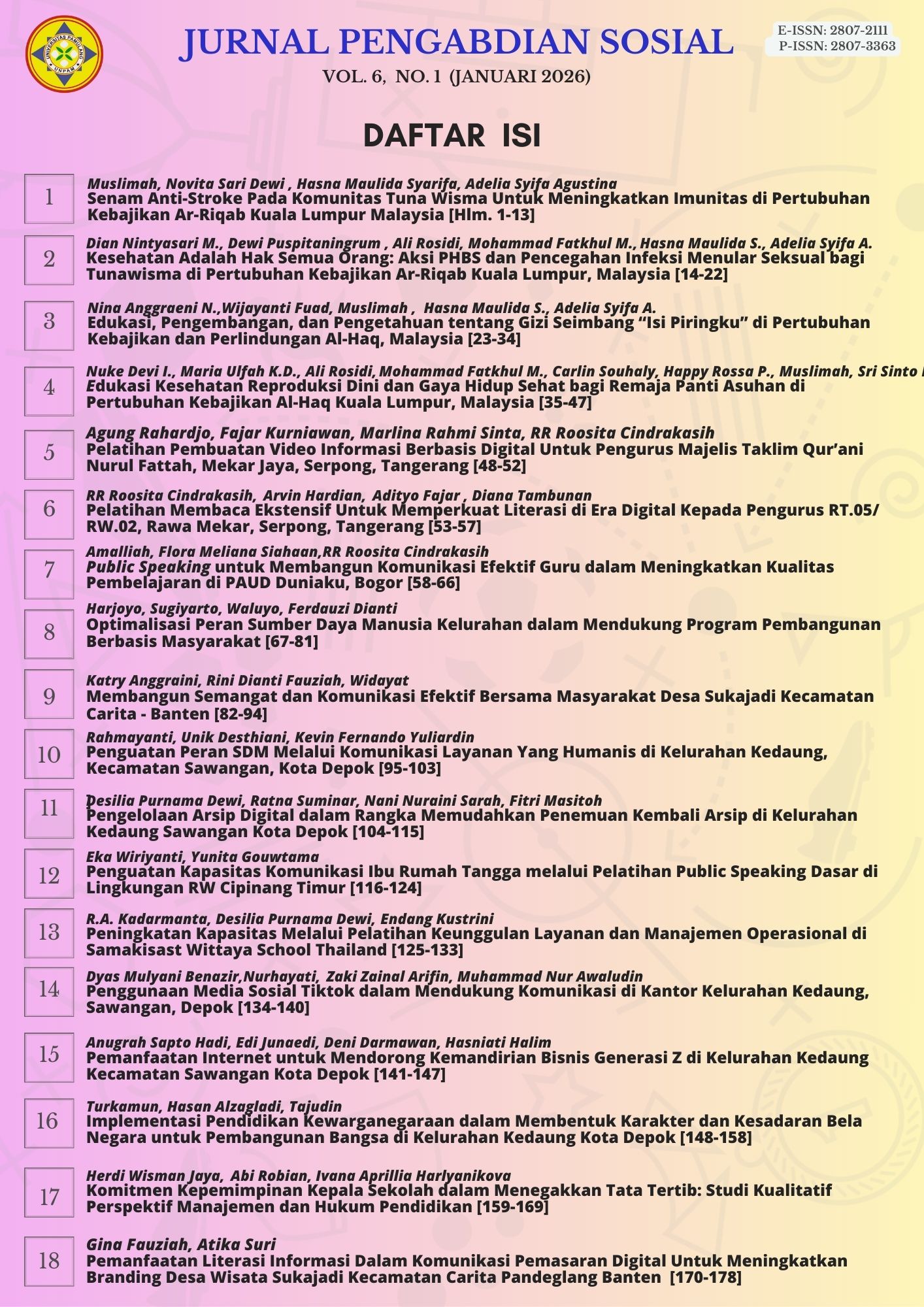
Kesehatan adalah Hak Semua Orang: Aksi PHBS dan Pencegahan Infeksi Menular Seksual bagi Tunawisma di Pertubuhan Kebajikan Ar-Riqab Kuala Lumpur Malaysia
DOI:
https://doi.org/10.32493/pbs.v6i1.57104Keywords:
PHBS, tunawisma, infeksi menular seksual, promosi kesehatan, peer educatorAbstract
Kelompok tunawisma memiliki kerentanan tinggi terhadap infeksi menular seksual (IMS) akibat perilaku berisiko, lingkungan hidup tidak sehat, dan akses layanan kesehatan yang terbatas; intervensi Perilaku Hidup Bersih dan Sehat (PHBS) diperlukan guna memperkuat praktik kebersihan diri dan seks aman. Program pengabdian ini bermitra dengan Pertubuhan Kebajikan Ar-Riqab (PKAR), Kuala Lumpur, untuk: (1) meningkatkan pengetahuan PHBS dan IMS; (2) mendorong perubahan perilaku nyata (cuci tangan, kebersihan diri, penggunaan kondom); (3) memfasilitasi akses konseling/skrining IMS; dan (4) memperkuat dukungan sosial. Metode meliputi penyuluhan interaktif (diskusi dan simulasi PHBS serta seks aman), layanan mobile untuk konseling, distribusi sarana kebersihan/edukasi, serta kolaborasi multisektor; evaluasi dilakukan melalui pre–post test pengetahuan, observasi perilaku (pemanfaatan fasilitas cuci tangan dan penggunaan kondom), serta umpan balik peserta. Program diharapkan menghasilkan peningkatan skor pengetahuan, praktik kebersihan personal yang lebih konsisten, perluasan rujukan ke layanan IMS, dan pembentukan peer educator sebagai strategi keberlanjutan.
References
Fact Sheet No. 31: The Right to Health | OHCHR. (n.d.). Retrieved October 8, 2025, from https://www.ohchr.org/en/publications/fact-sheets/fact-sheet-no-31-right-health
Fazel, S., Geddes, J. R., & Kushel, M. (2014). The health of homeless people in high-income countries: descriptive epidemiology, health consequences, and clinical and policy recommendations. Lancet (London, England), 384(9953), 1529. https://doi.org/10.1016/S0140-6736(14)61132-6
Felipetto, L. G., Teider-Junior, P. I., da Silva, F. F. V., Couto, A. C. do, Kmetiuk, L. B., Martins, C. M., Ullmann, L. S., Timenetsky, J., Santos, A. P. dos, & Biondo, A. W. (2021). Serosurvey of anti-treponema pallidum (syphilis), anti-hepatitis C virus and anti-HIV antibodies in homeless persons of São Paulo city, southeastern Brazil. The Brazilian Journal of Infectious Diseases, 25(4), 101602. https://doi.org/10.1016/J.BJID.2021.101602
He, J., Wang, Y., Du, Z., Liao, J., He, N., & Hao, Y. (2020). Peer education for HIV prevention among high-risk groups: A systematic review and meta-analysis. BMC Infectious Diseases, 20(1), 1–20. https://doi.org/10.1186/S12879-020-05003-9/FIGURES/7
Human rights. (n.d.). Retrieved October 8, 2025, from https://www.who.int/news-room/fact-sheets/detail/human-rights-and-health
Medley, A., Kennedy, C., O’Reilly, K., & Sweat, M. (2009). Effectiveness of Peer Education Interventions for HIV Prevention in Developing Countries: A Systematic Review and Meta-Analysis. AIDS Education and Prevention : Official Publication of the International Society for AIDS Education, 21(3), 181. https://doi.org/10.1521/AEAP.2009.21.3.181
Pinto, V. M., Tancredi, M. V., De Alencar, H. D. R., Camolesi, E., Holcman, M. M., Grecco, J. P., Grangeiro, A., & Grecco, E. T. O. (2014). Prevalence of Syphilis and associated factors in homeless people of Sao Paulo, Brazil, using a Rapid Test. Revista Brasileira de Epidemiologia, 17(2), 341–354. https://doi.org/10.1590/1809-4503201400020005ENG