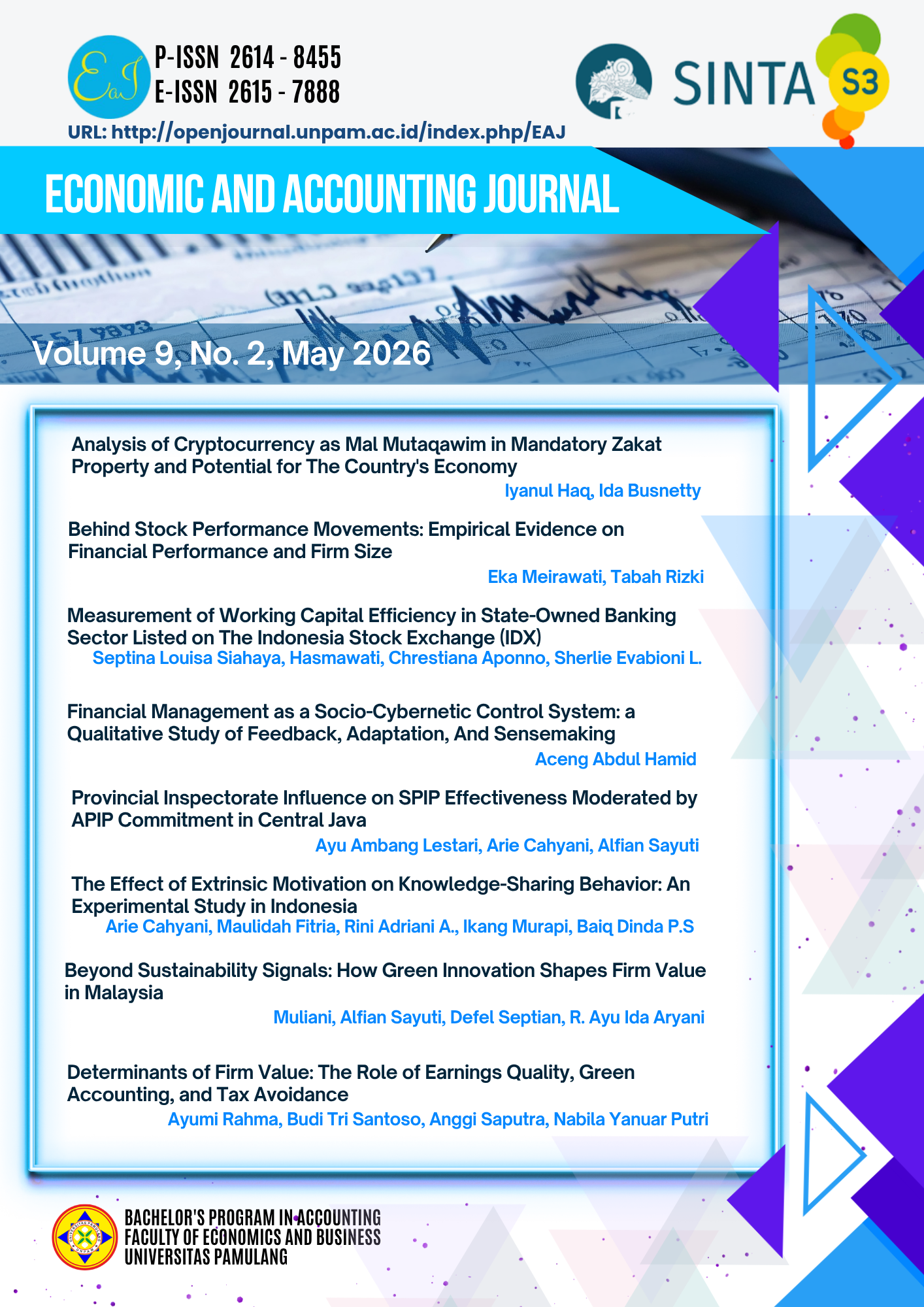
Beyond Sustainability Signals: How Green Innovation Shapes Firm Value in Malaysia
DOI:
https://doi.org/10.32493/eaj.v9i2.y2026.p166-181Keywords:
ESG, SRI, firm value, green innovation, Tobin’s QAbstract
This study examines the influence of Environmental, Social, and Governance (ESG) and Socially Responsible Investment (SRI) on firm value, proxied by Tobin's Q, with green innovation as a moderator variable. Rising global concerns about sustainability have prompted companies to integrate ESG practices and attract SRI-oriented investors. This study uses a quantitative approach with panel data from public companies. Data is collected from annual reports and sustainability reports. The analysis was carried out using regression analysis with moderation using panel data analysis, with the best models being FEM and GLS, which were more effective after model correction. The findings show that ESG and green innovation have a positive and significant impact on firm value, whereas SRI has no significant effect on firm value. In addition, green innovation strengthens the relationship between ESG and firm value, suggesting that companies engaged in green innovation get a higher market rating, but green innovation has no significant effect on the relationship between SRI and firm value. Control variables such as firm size also show a significant influence on the value of the company. The study contributes to the literature by highlighting the importance of sustainability practices and innovation in increasing company value.
References
Alsharo, M., Gregg, D., & Ramirez, R. (2017). Virtual team effectiveness: The role of knowledge sharing and trust. Information and Management, 54(4), 479–490. https://doi.org/10.1016/j.im.2016.10.005
Baytok, A., Kurt, M., & Zorlu, Ö. (2014). The role of transformational leader on knowledge sharing practices : A study about international hotel chains. European Journal of Business and Management, 6(7), 46–61.
Bock, G.-W., & Kim, Y.-G. (2002). Breaking the Myths of Rewards: An Exploratory Study of Attitudes about Knowledge Sharing. Information Resources Management Journal (IRMJ), 15(2), 14–21. https://doi.org/10.4018/irmj.2002040102
Bock, G.-W., Zmud, R. W., Kim, Y.-G., & Lee, J.-N. L. (2005). Behavioral Intention94 Formation in Knowledge Sharing: Examining the Roles of Extrinsic Motivators, Social-PsychologicalForces, and Organizational Climate. 29(1), 87–111.
Cheng, M. M., & Coyte, R. (2014). The effects of incentive subjectivity and strategy communication on knowledge-sharing and extra-role behaviours. Management Accounting Research, 25(2), 119–130.
https://doi.org/10.1016/j.mar.2013.07.003
Chiang, F. F. T., & Birtch, T. A. (2012). The Performance Implications of Finansial and Non-Financial Rewards: An Asian Nordic Comparison. Journal of Management Studies, 49(3), 538–570. https://doi.org/10.1111/j.1467- 6486.2011.01018.x
Deci, E. L., & Ryan, R. M. (2000). Psychological Inquiry : An International Journal for the Advancement of Psychological Theory The " What " and " Why " of95 Goal Pursuits : Human Needs and the Self-Determination of Behavior The “What” and “Why” of Goal Pursuits : Human Needs and the Sel. Psychological Inquiry, 11(4), 37–41.
Ding, X. H., He, Y., Wu, J., & Cheng, C. (2016). Effects of positive incentive and negative incentive in knowledge transfer: carrot and stick. Chinese Management Studies, 10(3), 593–614. https://doi.org/10.1108/CMS-01-2016-0006
Gagné, M., Tian, A. W., Soo, C., Zhang, B., Ho, K. S. B., & Hosszu, K. (2019). Different motivations for knowledge sharing and hiding: The role of motivating work design. Journal of Organizational Behavior, 40(7), 783–799. https://doi.org/10.1002/job.2364
Haesebrouck, K., Cools, M., & Van Den Abbeele, A. (2018). Status differences and knowledge transfer: The effect of incentives. Accounting Review, 93(1), 213– 234. https://doi.org/10.2308/accr-51765
Hau, Y. S., Kim, B., Lee, H., & Kim, Y. G. (2013). The effects of individual motivations and social capital on employees’ tacit and explicit knowledge sharing intentions. International Journal of Information Management, 33(2), 356–366. https://doi.org/10.1016/j.ijinfomgt.2012.10.009
Ilyana, S., & Sholihin, M. (2021). The Effect Of Incentives And Leadership Styles. 36(1), 14–30.
Jensen, M. C., & Meckling, W. H. (1976). Theory oh the Firm: Managerial Behavior, Agency Costs and Ownership Structure. Journal of Financial Economics, 3, 305–360.
Kankanhalli, A., Tan, B. C. Y., & Wei, K.-K. (2005). Contributing knowledge to electronic knowledge repositories. An Empirical Investigation, 29(1), 113–143. http://www.scopus.com/inward/record.url?scp=28744434462&partnerID=8YFLogxK%0Ahttps://www.scopus.com/record/pubmetrics.uri?eid=2-s2.0 28744434462&origin=recordpage
Kettles, D., St. Louis, R. D., & Steinbart, P. J. (2017). An experimental investigation of the individual and joint effects of financial and non-financial incentives on knowledge sharing using enterprise social media. Communications of the Association for Information Systems, 41(1), 639–673.https://doi.org/10.17705/1CAIS.04127
Kistyanto, A., & Wahyuni, R. R. T. (2013). Pengaruh Berbagi Pengetahuan Terhadap Kinerja Departemen Melalui Inovasi Jasa/Pelayanan. Jurnal Ilmu Manajemen, 1.
Lam, A., & Lambermont-Ford, J. P. (2010). Knowledge sharing in organisational contexts: A motivation-based perspective. Journal of Knowledge Management, 14(1), 51–66. https://doi.org/10.1108/13673271011015561
Liu, H., & Li, G. (2017). To gain or not to lose? The effect of monetary reward on motivation and knowledge contribution. Journal of Knowledge Management, 21(2), 397–415. https://doi.org/10.1108/JKM-03-2016-0100
Masa’deh, R., Obeidat, B. Y., & Tarhini, A. (2016). A Jordanian empirical study of the associations among transformational leadership, transactional leadership, knowledge sharing, job performance, and firm performance: A structural equation modelling approach. Journal of Management Development, 35(5), 681–705. https://doi.org/10.1108/JMD-09-2015-0134
Park, J., Lee, H., & Lee, J. (2013). Exploring Antecedents of Knowledge Sharing in Team-based Innovation Activities. 253–271. doi: 10.9716/kits.2013.12.3.253
Peng, H. (2013). Why and when do people hide knowledge? Journal of Knowledge Management, 17(3), 398–415. https://doi.org/10.1108/JKM-12-2012-0380
Šajeva, S. (2014). Encouraging Knowledge Sharing among Employees: How Reward Matters. Procedia - Social and Behavioral Sciences, 156(April), 130–134. https://doi.org/10.1016/j.sbspro.2014.11.134
Wang, S., Noe, R. A., & Wang, Z. M. (2014). Motivating Knowledge Sharing in Knowledge Management Systems: A Quasi-Field Experiment. Journal of Management, 40(4), 978–1009. https://doi.org/10.1177/0149206311412192
Wolfe, C., & Lorass, T. (2008). Knowledge Sharing : The Effects of Incentive, Environment, and Person. Journal of Information Systems, 22(2), 53–76.
Xia, Q., Yan, S., Zhang, Y., & Chen, B. (2019). The curvilinear relationship between knowledge leadership and knowledge hiding: The moderating role of psychological ownership. Leadership and Organization Development Journal, 40(6), 669–683. https://doi.org/10.1108/LODJ-10-2018-0362
Zhang, Zhen, & Min, M. (2021). Organizational rewards and knowledge hiding: task attributes as contingencies. Management Decision, 71902107. https://doi.org/10.1108/MD-02-2020-015
Additional Files
Published
Issue
Section
License
Copyright (c) 2026 Muliani UGB, Alfian Sayuti, Defel Septian, R. Ayu Ida Aryani

This work is licensed under a Creative Commons Attribution-ShareAlike 4.0 International License.
Authors who publish with this journal agree to the following terms:
- Authors retain copyright and grant the journal right of first publication with the work simultaneously licensed under a Creative Commons Attribution License that allows others to share the work with an acknowledgement of the work's authorship and initial publication in this journal.
- Authors are able to enter into separate, additional contractual arrangements for the non-exclusive distribution of the journal's published version of the work (e.g., post it to an institutional repository or publish it in a book), with an acknowledgement of its initial publication in this journal.
- Authors are permitted and encouraged to post their work online (e.g., in institutional repositories or on their website) prior to and during the submission process, as it can lead to productive exchanges, as well as earlier and greater citation of published work (See The Effect of Open Access).

This work is licensed under a Creative Commons Attribution-ShareAlike 4.0 International License.
 PUBLICATION ETHICS
 FOCUS AND SCOPE
 EDITORIAL TEAM
 REVIEW PROCESS
 CONTACT US
 AUTHOR GUIDELINES