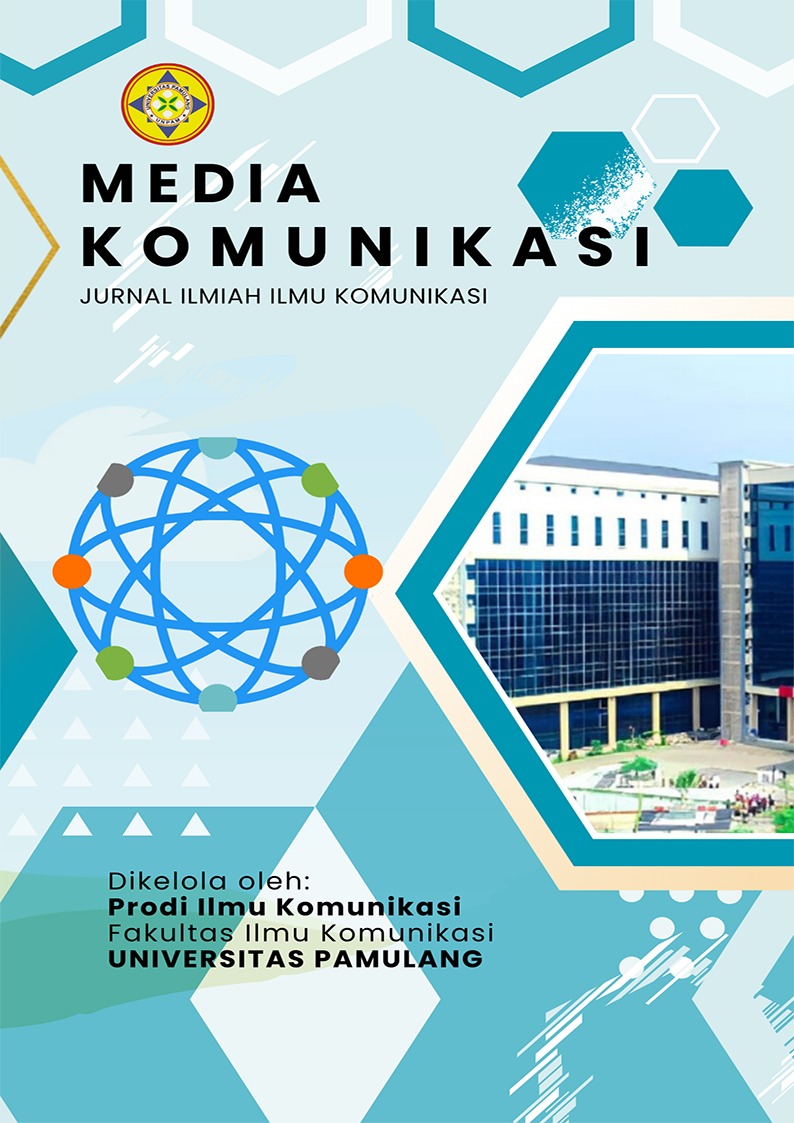
Analisis Fenomena Digital ‘Goyang Sadbor’ dalam Perspektif Interaksi Simbolik, Difusi Inovasi, dan Ekonomi Kreatif
DOI:
https://doi.org/10.32493/mdkm.v2i2.49867Keywords:
Goyang Sadbor, media sosial, interaksi simbolik, difusi inovasi, ekonomi kreatif.Abstract
Fenomena Goyang Sadbor telah menjadi tren viral di media sosial, khususnya TikTok, yang melibatkan interaksi aktif antara kreator dan audiens. Studi ini menganalisis fenomena tersebut menggunakan tiga perspektif teoretis: Teori Interaksi Simbolik, Teori Difusi Inovasi, dan Teori Ekonomi Kreatif. Berdasarkan Teori Interaksi Simbolik, Goyang Sadbor bukan sekadar tarian, tetapi juga membentuk makna sosial baru di dunia digital melalui interaksi antara kreator dan penggemarnya. Dari sudut pandang Teori Difusi Inovasi, tren ini menyebar dari komunitas lokal di Kampung Margasari ke audiens yang lebih luas melalui media sosial, menunjukkan bagaimana inovasi dalam budaya digital dapat diterima dan diadopsi oleh masyarakat. Sementara itu, Teori Ekonomi Kreatif menjelaskan bagaimana Goyang Sadbor berkontribusi terhadap ekonomi berbasis kreativitas, di mana para kreator mendapatkan penghasilan dari donasi live streaming, endorsement, dan peluang bisnis lainnya. Dengan menggunakan pendekatan kualitatif, penelitian ini mengungkap bahwa Goyang Sadbor tidak hanya menjadi fenomena hiburan, tetapi juga mencerminkan perubahan dalam pola interaksi sosial dan ekonomi digital masyarakat.
References
Bandura, A. (2001). Social cognitive theory of mass communication. Media Psychology, 3(3), 265–299. https://doi.org/10.1207/S1532785XMEP0303_03
Baudrillard, J. (1994). Simulacra and Simulation. University of Michigan Press.
Berger, P. L., & Luckmann, T. (1966). The social construction of reality: A treatise in the sociology of knowledge. Garden City, NY: Anchor Books.
Blumer, H. (1969). Symbolic interactionism: Perspective and method. Englewood Cliffs, NJ: Prentice-Hall.
Blumer, H. (1969). Symbolic Interactionism: Perspective and Method. University of California Press.
Cunningham, S., & Flew, T. (2016). Creative Industries and the Digital Economy. In S. Cunningham & T. Flew (Eds.), The Routledge Companion to Media and the Global South (pp. 280–296). Routledge.
Denzin, N. K., & Lincoln, Y. S. (2005). The SAGE Handbook of Qualitative Research (3rd ed.). SAGE Publications.
Fuchs, C. (2017). Social Media: A Critical Introduction. SAGE Publications.
Gill, R., & Pratt, A. C. (2008). In the Name of Creativity: A Critical Critique of the Creative Industries Discourse. Geoforum, 39(3), 963–973.
Howkins, J. (2001). The Creative Economy: How People Make Money from Ideas. Penguin Books.
Jenkins, H. (2006). Convergence culture: Where old and new media collide. New York, NY: New York University Press.
Jenkins, H. (2006). Convergence Culture: Where Old and New Media Collide. New York University Press.
Katz, E., & Lazarsfeld, P. F. (1955). Personal influence: The part played by people in the flow of mass communications. Glencoe, IL: Free Press.
Kozinets, R. V. (2002). The Field Behind the Screen: Using Netnography for Marketing Research in Online Communities. Journal of Marketing Research, 39(1), 61–72.
Kozinets, R. V. (2010). Netnography: Doing Ethnographic Research Online. SAGE Publications.
Krippendorff, K. (2004). Content Analysis: An Introduction to Its Methodology (2nd ed.). SAGE Publications.
Lister, M., Dovey, J., Giddings, S., Grant, I., & Kelly, K. (2009). New Media: A Critical Introduction (2nd ed.). Routledge.
McLuhan, M. (1964). Understanding Media: The Extensions of Man. McGraw-Hill.
McQuail, D. (2010). McQuail’s mass communication theory (6th ed.). London: SAGE Publications.
Rogers, E. M. (2003). Diffusion of Innovations (5th ed.). Free Press.
Rogers, E. M. (2003). Diffusion of innovations (5th ed.). New York: Free Press.
Sen, K., & Hill, D. T. (2000). Media, culture and politics in Indonesia. Melbourne: Oxford University Press.
Srnicek, N. (2017). Platform capitalism. Cambridge, UK: Polity Press.
Tapscott, D., & Williams, A. D. (2006). Wikinomics: How mass collaboration changes everything. New York: Portfolio.
Towse, R. (2010). A textbook of cultural economics. Cambridge, UK: Cambridge University Press.
Downloads
Published
How to Cite
Issue
Section
License
Copyright (c) 2025 Faisal Faisal

This work is licensed under a Creative Commons Attribution-ShareAlike 4.0 International License.
Authors who publish with this journal agree to the following terms:
1. Authors retain copyright and grant the journal right of first publication with the work simultaneously licensed under creativecommons.org/licenses/by-sa/4.0 that allows others to share the work with an acknowledgement of the work's authorship and initial publication in this journal.
2. Authors are able to enter into separate, additional contractual arrangements for the non-exclusive distribution of the journal's published version of the work (e.g., post it to an institutional repository or publish it in a book), with an acknowledgement of its initial publication in this journal.
Authors are permitted and encouraged to post their work online (e.g., in institutional repositories or on their website) prior to and during the submission process, as it can lead to productive exchanges, as well as earlier and greater citation of published work (See The Effect of Open Access).
Jurnal Media Komunikasi have CC-BY-SA or an equivalent license as the optimal license for the publication, distribution, use, and reuse of scholarly work.
In developing strategy and setting priorities, Jurnal Ilmiah Teknik Kimia recognize that free access is better than priced access, libre access is better than free access, and libre under CC-BY-SA or the equivalent is better than libre under more restrictive open licenses. We should achieve what we can when we can. We should not delay achieving free in order to achieve libre, and we should not stop with free when we can achieve libre.

Jurnal Ilmiah Teknik Kimia is licensed under a Creative Commons Attribution 4.0 International License
YOU ARE FREE TO:
- Share — copy and redistribute the material in any medium or format
- Adapt — remix, transform, and build upon the material for any purpose, even commercially.
- The licensor cannot revoke these freedoms as long as you follow the license terms.
https://creativecommons.org/licenses/by-sa/4.0/