
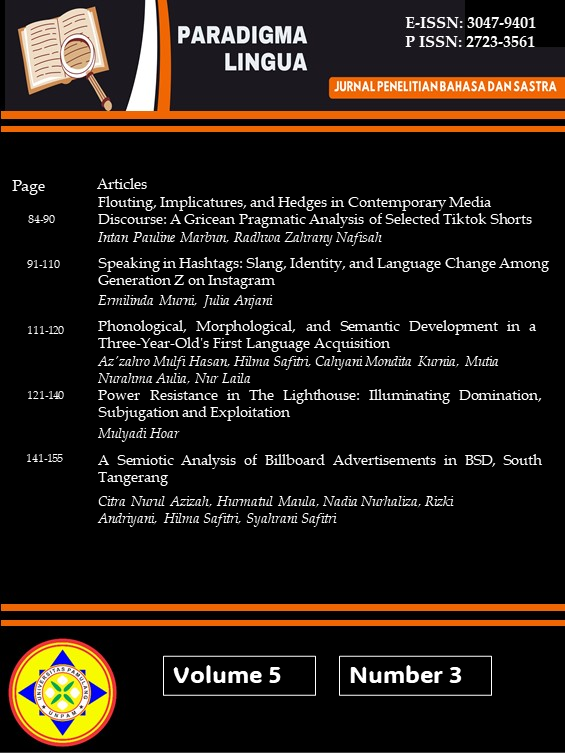
Speaking in Hashtags: Slang, Identity, and Language Change Among Generation Z on Instagram
Abstract
This study examines the use of slang among Generation Z on Instagram as a reflection of the evolving dynamics of digital language. Informed by sociolinguistic theories of language change, speech community, and digital discourse, the analysis explores how acronyms and abbreviations such as "IDC" (I Don’t Care), "ASAP" (As Soon As Possible), "LOL" (Laugh Out Loud), "Fav" (Favorite), and "Cuz" (Because) function beyond mere shorthand. These linguistic forms facilitate efficient, expressive communication and simultaneously signal group membership and identity within online youth communities. While slang enhances connectivity and creative expression, its widespread adoption also raises concerns about potential misunderstandings, generational divides, and the erosion of formal literacy. The findings highlight key pedagogical implications, emphasizing the need for educators to promote code-switching skills and digital literacy. Moreover, the study calls for inclusive policy efforts that recognize youth slang as a legitimate form of language innovation, while addressing its social and educational impacts. Culturally, slang is positioned not as linguistic decline but as a vibrant site of identity performance, social alignment, and resistance. The paper concludes by proposing directions for future research, including longitudinal, cross-platform, and ethnographic studies. These would further illuminate how digital environments shape not only how we communicate, but who we become through language.
References
Cismariu, L., Grosseck, G., Holotescu, C., & Andone, D. (2019). Generation Z and social media. Proceedings of the 14th International Conference on Virtual Learning (ICVL 2019), 367–374.
Gerring, J. (2017). Qualitative methods. Annual Review of Political Science, 20(1), 15–36. https://doi.org/10.1146/annurev-polisci-092415-024158
Napitu, F. E., & Suhardi. (2020). An analysis of slang word abbreviations in American captions on Instagram: A sociolinguistic approach. Journal Title (if available), 10(1), page numbers (if available). (Note: Please insert the journal title and complete details if available.)
Sabbagh, A. R. (2018). A close look at the function of slang. A Journal of Undergraduate Composition, 5(2), 114–134.
Yuniar, A. N. (2022). An analysis of English slang words discussed by slang content creators on TikTok and its contribution to language learning in speaking (Doctoral dissertation, Universitas PGRI Semarang).
Yap, E. J., & Saludez, L. M. (2022). Students’ morpho-pragmatic awareness of the codified Philippine English and millennial slang as input to teaching vocabulary in junior high school. Psychology and Education: A Multidisciplinary Journal, 3(8), 752–773.
Yusuf, Y. Q., Fitriani, S. S., & Muslimin, I. (2022). “Gotchuu!”: The use of slang in social media by Generation Z. Lingua, 17(2), page numbers (if available). (Note: Please complete with volume, issue, and page numbers if missing.)
Downloads
Published
How to Cite
Issue
Section
License
Authors who publish with this journal agree to the following terms:
- Authors retain copyright and grant the journal right of first publication with the work simultaneously licensed under a Creative Commons Attribution License that allows others to share the work with an acknowledgement of the work's authorship and initial publication in this journal.
- Authors are able to enter into separate, additional contractual arrangements for the non-exclusive distribution of the journal's published version of the work (e.g., post it to an institutional repository or publish it in a book), with an acknowledgement of its initial publication in this journal.
- Authors are permitted and encouraged to post their work online (e.g., in institutional repositories or on their website) prior to and during the submission process, as it can lead to productive exchanges, as well as earlier and greater citation of published work (See The Effect of Open Access).
Paradigma Lingua have CC-BY-SA or an equivalent license as the optimal license for the publication, distribution, use, and reuse of scholarly work.
In developing strategy and setting priorities, Paradigma Lingua recognize that free access is better than priced access, libre access is better than free access, and libre under CC-BY-SA or the equivalent is better than libre under more restrictive open licenses. We should achieve what we can when we can. We should not delay achieving free in order to achieve libre, and we should not stop with free when we can achieve libre.
