
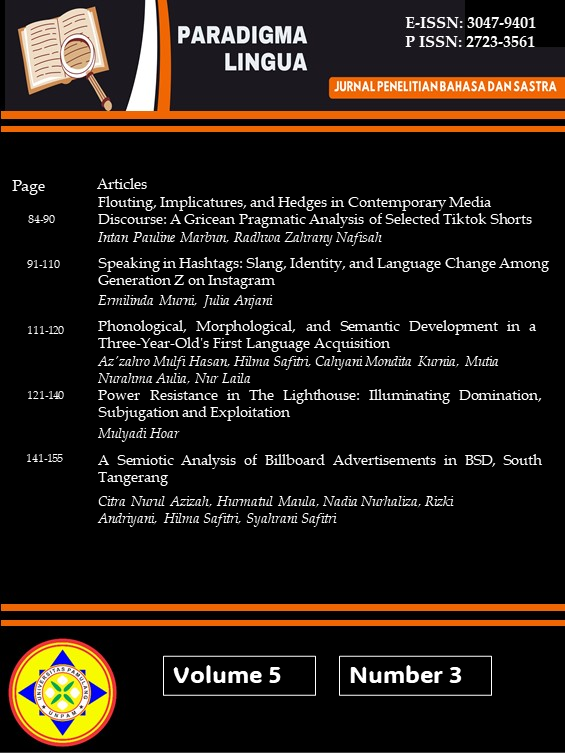
Flouting, Implicatures, and Hedges in Contemporary Media Discourse: A Gricean Pragmatic Analysis of Selected Tiktok Shorts
Keywords:
Grice's Maxims, Pragmatics, Flouting, Cooperative Principle, Conversational AnalysisAbstract
This study explores how real-life and fictional dialogues in popular media employ pragmatic strategies that both align with and subvert Grice’s Cooperative Principle (1975). Through a qualitative analysis of selected excerpts from The Lion King (2019), Frozen (2013), and celebrity interviews featuring Andrew Garfield and Jackson Wang, the paper examines how the maxims of quality, relevance, and manner are flouted, hedged, or indirectly manipulated to produce layered meaning. Findings reveal that speakers use implicature, hedging, and maxim flouting not as communicative failures but as intentional tools for managing social relationships, protecting face, expressing philosophical stances, or complying with professional constraints. For instance, Timon and Pumbaa’s "Hakuna Matata" reflects a reorientation of truth from factual accuracy to existential authenticity; Elsa’s veiled disapproval illustrates implicature functioning as a face-saving strategy; Kristoff’s use of “hopefully” exemplifies hedging for politeness and risk management. Meanwhile, Andrew Garfield’s ironic denial and Jackson Wang’s culturally sensitive deflection showcase strategic relevance manipulation in public discourse. The study underscores the enduring relevance of Gricean pragmatics in understanding how meaning is contextually negotiated and socially embedded in contemporary audiovisual texts. It also highlights the pedagogical potential of using popular media as a resource for teaching and analyzing pragmatic competence.
References
Attardo, S. (1993). Violation of conversational maxims and cooperation: The case of jokes. Journal of Pragmatics, 19(6), 537–558. https://doi.org/10.1016/0378-2166(93)90102-V
Brown, P., & Levinson, S. C. (1987). Politeness: Some universals in language usage. Cambridge University Press.
Cutting, J. (2002). Pragmatics and discourse: A resource book for students. Routledge.
Dynel, M. (2008). No aggression, only teasing: The pragmatics of teasing and banter. Lodging Complaints: Studies in Pragmatics, 5, 147–168.
Fraser, B. (2010). Pragmatic competence: The case of hedging. In R. Facchinetti, D. Crystal, & B. Seidlhofer (Eds.), From International to Local English—and Back Again (pp. 15–34). Peter Lang.
Grice, H. P. (1975). Logic and conversation. In P. Cole & J. L. Morgan (Eds.), Syntax and Semantics: Vol. 3. Speech Acts (pp. 41–58). Academic Press.
Holmes, J. (2013). An introduction to sociolinguistics (4th ed.). Routledge.
Levinson, S. C. (1983). Pragmatics. Cambridge University Press.
Mey, J. L. (2001). Pragmatics: An introduction (2nd ed.). Blackwell.
Sperber, D., & Wilson, D. (1995). Relevance: Communication and cognition (2nd ed.). Blackwell.
Yule, G. (1996). The study of language (2nd ed.). Cambridge University Press.
Downloads
Published
How to Cite
Issue
Section
License
Authors who publish with this journal agree to the following terms:
- Authors retain copyright and grant the journal right of first publication with the work simultaneously licensed under a Creative Commons Attribution License that allows others to share the work with an acknowledgement of the work's authorship and initial publication in this journal.
- Authors are able to enter into separate, additional contractual arrangements for the non-exclusive distribution of the journal's published version of the work (e.g., post it to an institutional repository or publish it in a book), with an acknowledgement of its initial publication in this journal.
- Authors are permitted and encouraged to post their work online (e.g., in institutional repositories or on their website) prior to and during the submission process, as it can lead to productive exchanges, as well as earlier and greater citation of published work (See The Effect of Open Access).
Paradigma Lingua have CC-BY-SA or an equivalent license as the optimal license for the publication, distribution, use, and reuse of scholarly work.
In developing strategy and setting priorities, Paradigma Lingua recognize that free access is better than priced access, libre access is better than free access, and libre under CC-BY-SA or the equivalent is better than libre under more restrictive open licenses. We should achieve what we can when we can. We should not delay achieving free in order to achieve libre, and we should not stop with free when we can achieve libre.
