
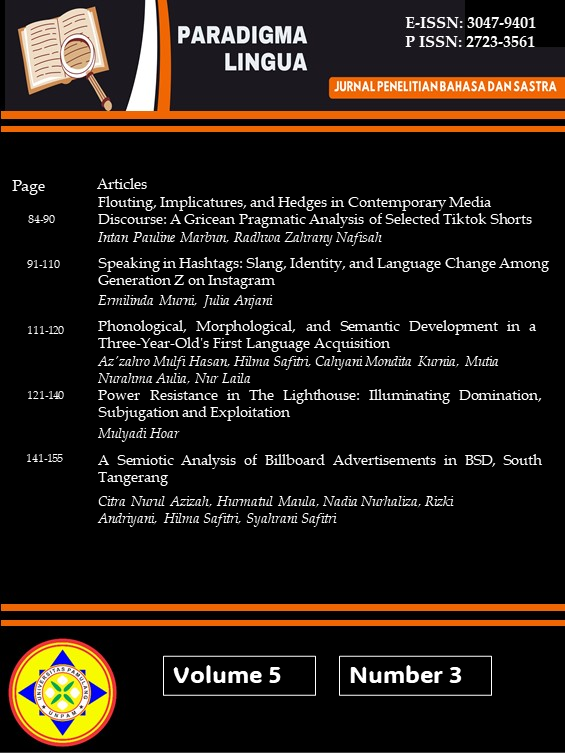
Phonological, Morphological, and Semantic Development in a Three-Year-Old's First Language Acquisition
Keywords:
Phonology, Morphology, Semantics, First Language AcquisitionAbstract
Language acquisition is a natural and foundational process that begins in early childhood, as children gradually develop the ability to understand and use their first language. This study investigates the early stages of language development in a three-year-old child, with a focus on three core linguistic components: phonology, morphology, and semantics. Data were collected through naturalistic observation and recorded interactions between the child and a researcher, which were transcribed for analysis. The findings reveal significant progress in all three areas. Phonologically, the child exhibits common developmental patterns such as simplification of complex sounds and preference for familiar phonemes. Morphological development is marked by the use of truncated and restructured word forms, reflecting early awareness of word formation despite incomplete structures. Semantically, the child is able to express preferences, describe familiar objects, and convey daily experiences, even with limited grammatical accuracy. The presence of typical age-related errors underscores a healthy and dynamic progression in language acquisition. Overall, the study highlights how cognitive growth and social interaction jointly shape language development during early childhood.
References
Aronoff, M., & Fudeman, K. (2011). What is Morphology? (2nd ed.). Wiley-Blackwell.
Barrett, M. (1995). Early lexical development. In P. Fletcher & B. MacWhinney (Eds.), The Handbook of Child Language (pp. 362–392). Blackwell.
Bavin, E. L. (2009). The Cambridge Handbook of Child Language. Cambridge University Press.
Bloom, L., & Lahey, M. (1978). Language Development and Language Disorders. Wiley.
Clark, E. V. (2003). First Language Acquisition (2nd ed.). Cambridge University Press.
Clark, E. V. (2003). First Language Acquisition. Cambridge University Press.
Flynn, J. (2016). Phonological Acquisition and Development in Early Childhood. Routledge.
Genesee, F., Paradis, J., & Crago, M. B. (2004). Dual Language Development and Disorders: A Handbook on Bilingualism and Second Language Learning. Brookes Publishing.
Laing, C. (2017). Sound Patterns in Language Acquisition. Cambridge University Press.
Naser, A., & Gandhi, P. (2024). Child Language Acquisition and Cognitive Strategies. Oxford Linguistics.
Nilsen, E., & Fox, J. (2020). Morphological Development in Children: Processes and Patterns. Routledge.
Peter, L. (2024). Morphology and Meaning: Early Linguistic Patterns in Children. Palgrave Macmillan.
Saeed, J. I. (2016). Semantics (4th ed.). Wiley-Blackwell.
Tomasello, M. (2000). The Cultural Origins of Human Cognition. Harvard University Press.
Vigliocco, G., Vinson, D. P., & Siriwardena, N. (2006). The role of meaning in lexical acquisition. Developmental Psychology, 42(6), 1189–1206.
Vihman, M. M. (2014). Phonological Development: The First Two Years (2nd ed.). Wiley-Blackwell.
Yavas, M. (2011). Applied English Phonology. Wiley-Blackwell.
Downloads
Published
How to Cite
Issue
Section
License
Authors who publish with this journal agree to the following terms:
- Authors retain copyright and grant the journal right of first publication with the work simultaneously licensed under a Creative Commons Attribution License that allows others to share the work with an acknowledgement of the work's authorship and initial publication in this journal.
- Authors are able to enter into separate, additional contractual arrangements for the non-exclusive distribution of the journal's published version of the work (e.g., post it to an institutional repository or publish it in a book), with an acknowledgement of its initial publication in this journal.
- Authors are permitted and encouraged to post their work online (e.g., in institutional repositories or on their website) prior to and during the submission process, as it can lead to productive exchanges, as well as earlier and greater citation of published work (See The Effect of Open Access).
Paradigma Lingua have CC-BY-SA or an equivalent license as the optimal license for the publication, distribution, use, and reuse of scholarly work.
In developing strategy and setting priorities, Paradigma Lingua recognize that free access is better than priced access, libre access is better than free access, and libre under CC-BY-SA or the equivalent is better than libre under more restrictive open licenses. We should achieve what we can when we can. We should not delay achieving free in order to achieve libre, and we should not stop with free when we can achieve libre.
