
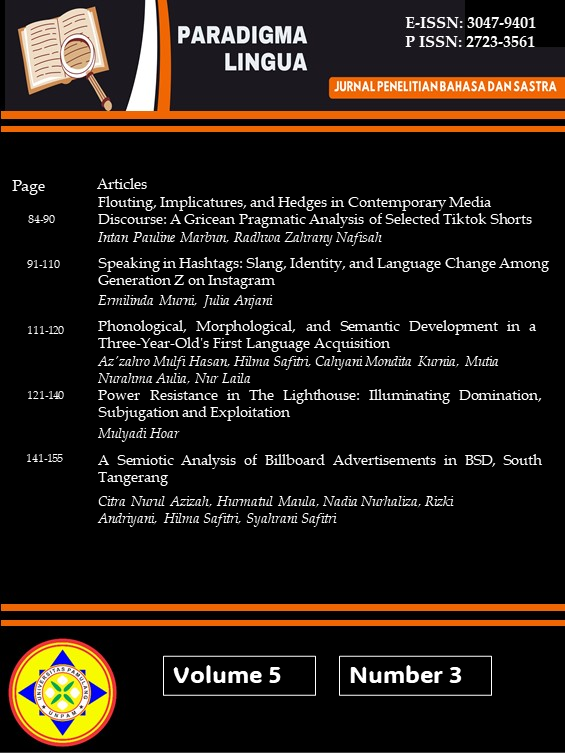
Power Resistance in The Lighthouse: Illuminating Domination, Subjugation and Exploitation
Keywords:
subjugation, power resistance, Michel Foucault, exploitation, dominationAbstract
This study investigates how power is exercised and resisted in Robert Eggers’ The Lighthouse (2019), a psychological film depicting two isolated lighthouse keepers in a deteriorating relationship. Using a qualitative descriptive approach, this research analyzes selected scenes through both narrative and cinematographic elements to reveal the dynamics of power and its resistance. Drawing on Michel Foucault’s theory of power relations, the study adopts a post-structuralist critical framework to examine how domination, subjugation, and exploitation function as discursive mechanisms of control. In Foucault’s terms, power is not merely repressive but relational and productive, exercised upon the actions of others and always met with forms of resistance. This research finds that the supervisor figure enacts power through threats, identity construction, and control over labor, while the assistant engages in both verbal and non-verbal resistance—challenging authority, identity labels, and withheld economic rewards. These power struggles are also visually represented through shot composition, lighting, and character blocking. The findings demonstrate how film can function as a discursive site where power relations are not only portrayed but also critically interrogated. This study contributes to the expanding discourse on cinematic representations of power and resistance, and it underscores the utility of Foucauldian theory in film criticism.
References
Abrams, M. H. (1999). A Glossary of Literal Terms. Seventh Edition. Heinle & Heinle.
Barden, Thomas E. (n.d.). Why Study Literature at All?. In Constantakis (Ed.), Short Stories for Students: Presenting Analysis, Context, and Criticism on Commonly Studied Short Stories (pp. ix-x). Gale Cengage Learning.
Bordwell, D., & Thompson, K. (2008). Film art: An introduction. McGraw-Hill.
Constantakis, S., & Barden, T.E. (2010). Short Stories for Students: Presenting Analysis, Context, and Criticism on Commonly Studied Short Stories. Gale Cengage Learning.
Dise, J. (2016). Filmmaking 101: Camera shot types. September 20, 2016. https://www.bhphotovideo.com/explora/video/tips-andsolutions/filmmaking-101-camera-shot-types
Foucault, M. (1997). What is enlightenment? [1984]. In Ethics: subjectivity and truth (the essential works of Micehl Foucault, 1954-1984).
Foucault, Michel (1982): ‘The subject and power’. Critical Inquiry, vol. 8, no. 4, pp. 777–95.
Foucault, M. (1978). Discipline and Punish: The Birth of the Prison. Pantheon Books.
Freytag, G. (1900). Freytag’s Technique of the Drama, An Exposition of Dramatic Composition and Art by Dr Gustav Freytag: An Authorized Translation of the Sixth German Edition. Foresman and Company.
Nestiananta, Y., G. (2017). The Portrayal of Power Relation in Film Snowpiercer: A Foucauldian Study [undergraduate thesis, Universitas Airlangga]. Repository Universitas Airlangga. http://repository.unair.ac.id/64414/
Raeske, C. R. (1996). How to Analyze Drama. Monarch Press.
Sejahterawati, N. F., Language, E., & Indonesia, U. P. (2019). An Analysis of Power Relations in Kanae Minato’s Novel Confessions (2008). Passage, 7(3), 59–74.
Stanton, R. (1965). An Introduction to Fiction. Rinehart and Winston.
Suciyati, M. (2011). Representation of Power Relations in Death Race [undergraduate thesis, State University of Malang]. Karya-Ilmiah UM. http://karya-ilmiah.um.ac.id/index.php/sastra-inggris/article/view/15676
Shaikh, U. (2019). Aristotle ’ s Theory of Powers [doctorate thesis, University of Michigan]. Deep Blue Repositories. https://deepblue.lib.umich.edu/bitstream/handle/2027.42/153366/umer_1.pdf?sequence=1
Yilmaz, K. (2013). Comparison of quantitative and qualitative research traditions: Epistemological, theoretical, and methodological differences. European Journal of Education, 48(2), 311–325. https://doi.org/10.1111/ejed.12014
Downloads
Published
How to Cite
Issue
Section
License
Authors who publish with this journal agree to the following terms:
- Authors retain copyright and grant the journal right of first publication with the work simultaneously licensed under a Creative Commons Attribution License that allows others to share the work with an acknowledgement of the work's authorship and initial publication in this journal.
- Authors are able to enter into separate, additional contractual arrangements for the non-exclusive distribution of the journal's published version of the work (e.g., post it to an institutional repository or publish it in a book), with an acknowledgement of its initial publication in this journal.
- Authors are permitted and encouraged to post their work online (e.g., in institutional repositories or on their website) prior to and during the submission process, as it can lead to productive exchanges, as well as earlier and greater citation of published work (See The Effect of Open Access).
Paradigma Lingua have CC-BY-SA or an equivalent license as the optimal license for the publication, distribution, use, and reuse of scholarly work.
In developing strategy and setting priorities, Paradigma Lingua recognize that free access is better than priced access, libre access is better than free access, and libre under CC-BY-SA or the equivalent is better than libre under more restrictive open licenses. We should achieve what we can when we can. We should not delay achieving free in order to achieve libre, and we should not stop with free when we can achieve libre.
