About the Journal
Focus and Scope
Pamulang Law Review (PalRev) is a peer-reviewed scholarly journal published by the Faculty of Law, Universitas Pamulang. The journal serves as an academic platform for the dissemination of high-quality legal research, theoretical analyses, and critical studies addressing contemporary legal issues within national, comparative, and international contexts. PalRev welcomes contributions from academics, researchers, legal practitioners, policymakers, and scholars seeking to advance legal knowledge and promote interdisciplinary legal discourse.
The journal publishes original research articles, conceptual papers, and critical reviews that examine legal developments, regulatory frameworks, judicial practices, and emerging legal challenges in both traditional and modern legal systems. Emphasis is placed on innovative, analytical, and evidence-based scholarship that contributes to the development of legal science and public policy.
The scope of the journal includes, but is not limited to, the following fields:
- Criminal Law;
- Civil Law;
- Constitutional Law;
- Administrative Law;
- Agrarian and Land Law;
- Economic and Business Law;
- Islamic Law;
- Customary and Indigenous Law;
- International Law;
- Labour and Employment Law.
PalRev encourages interdisciplinary, comparative, normative, and empirical approaches to legal research and welcomes manuscripts that provide theoretical contributions, practical implications, and policy recommendations relevant to contemporary legal challenges at the national, regional, and global levels.
Peer Review Process
All papers are fully peer-reviewed. We only publish articles that have been reviewed and approved by highly qualified researchers with expertise in a field appropriate (at least two reviewers per article). We used double-blind peer-reviewing process. Detailed information about the flow for the manuscript submission (author) to the acceptance by editor is shown in the following figure.
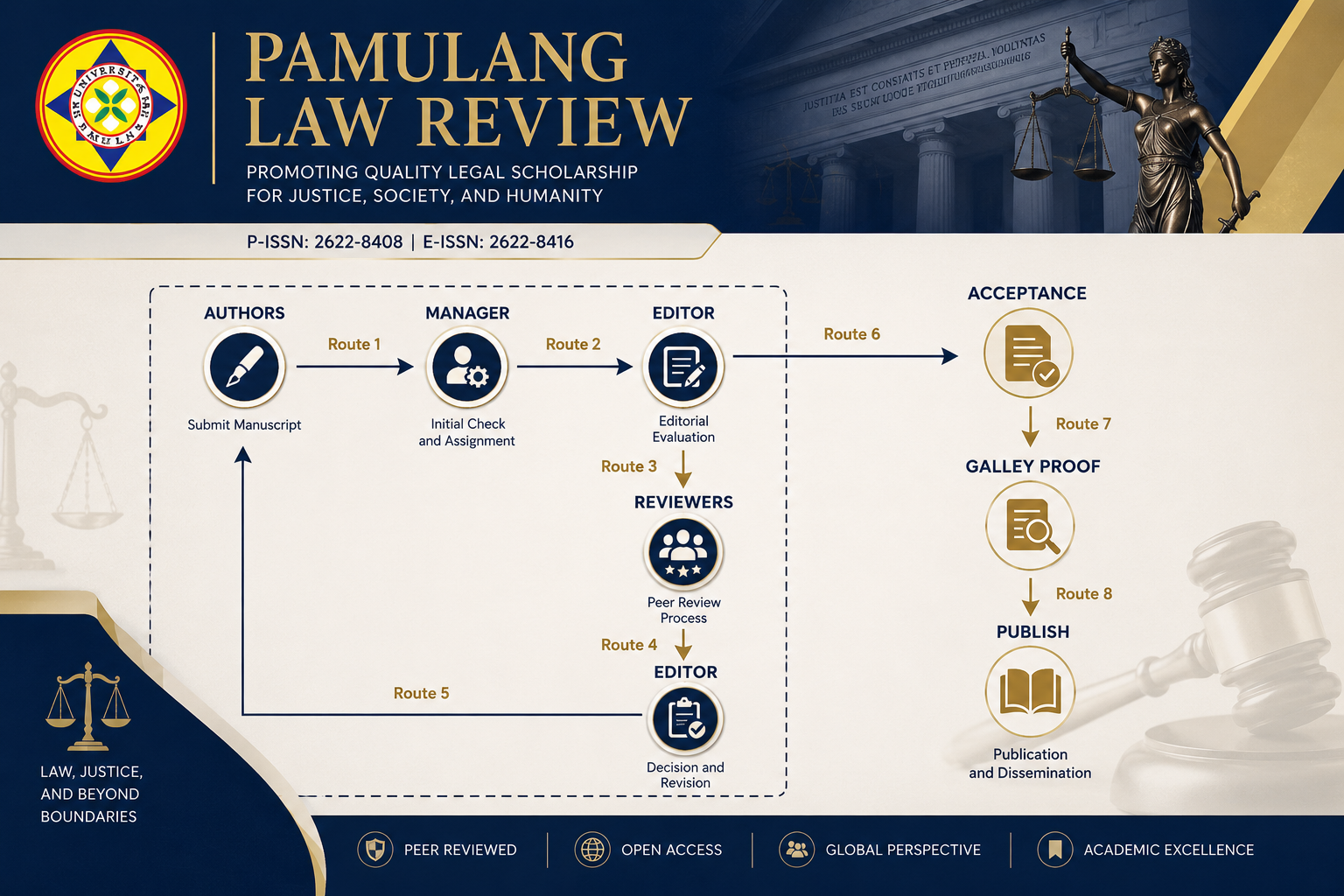
In short, the steps are:
- Manuscript Submission (by author) (route 1)
- Manuscript Check and Selection (by manager and editors) (route 2). Editors have a right to directly accept, reject, or review. Prior to further processing steps, plagiarism check using Turnitin is applied for each manuscript.
- Manuscript Reviewing Process (by reviewers) (route 3-4)
- Notification of Manuscript Acceptance, Revision, or Rejection (by editor to author based on reviewers comments) (route 5)
- Paper Revision (by author)
- Revision Submission based on Reviewer Suggestion (by author) with the similar flow to point number 1. (route 1)
- If the reviewer seems to be satisfied with revision, notification for acceptance (by editor). (route 6)
- Galley proof and publishing process (route 7 and 8)
The steps point number 1 to 5 are considered as 1 round of the peer-reviewing process (see the grey area in the figure). The editor or editorial board considers the feedback provided by the peer reviewers and arrives at a decision. The following are the most common decisions:
- Accepted, as it is. The journal will publish the paper in its original form;
- Accepted by Minor Revisions, the journal will publish the paper and asks the author to make small corrections (let authors revised with stipulated time);
- Accepted by Major Revisions, the journal will publish the paper provided the authors make the changes suggested by the reviewers and/or editors (let authors revised with stipulated time);
- Resubmit (conditional rejection), the journal is willing to reconsider the paper in another round of decision making after the authors make major changes;
- Rejected (outright rejection), the journal will not publish the paper or reconsider it even if the authors make major revisions.
Open Access Policy
Pamulang Law Review (PalRev) is an open-access scholarly journal committed to ensuring the immediate and unrestricted availability of legal scholarship. All articles published by the journal are freely accessible to readers worldwide without subscription fees, registration requirements, or other access barriers. This policy reflects the journal's commitment to promoting the dissemination, visibility, and exchange of legal knowledge within national and international academic communities.
Authors retain copyright in their published works and grant Pamulang Law Review the right of first publication. All articles are published under the Creative Commons Attribution-ShareAlike 4.0 International License (CC BY-SA 4.0).
Under the CC BY-SA 4.0 license, users are permitted to copy and redistribute published material in any medium or format and to remix, transform, and build upon the material for any purpose, including commercial purposes, provided that appropriate credit is given to the original author(s), the original publication in Pamulang Law Review is properly acknowledged, a link to the applicable license is provided, and any adapted material is distributed under the same or a compatible license.
The journal encourages authors and readers to disseminate published articles through institutional repositories, academic platforms, personal or professional websites, and other appropriate scholarly channels in accordance with the applicable license. Through this open-access model, Pamulang Law Review seeks to enhance the accessibility, discoverability, and scholarly impact of legal research while supporting the broader advancement of legal knowledge.
License: Creative Commons Attribution-ShareAlike 4.0 International (CC BY-SA 4.0)
Creative Commons Attribution-ShareAlike 4.0 International
Archiving Policy
Pamulang Law Review (PalRev) is committed to maintaining the long-term accessibility, integrity, and availability of its published scholarly content. The journal recognizes digital preservation as an essential component of responsible scholarly publishing and seeks to ensure that published articles remain accessible as part of the permanent academic record.
Institutional Digital Preservation
Published content is maintained through the digital publishing infrastructure of Universitas Pamulang. The journal supports appropriate institutional maintenance, data management, and backup practices intended to safeguard published materials and maintain their continuing accessibility.
The journal periodically evaluates its digital preservation arrangements in accordance with developments in scholarly publishing infrastructure and recognized practices for maintaining the integrity and availability of electronic academic content.
Indexing and Metadata Dissemination
The journal supports the visibility and discoverability of its scholarly content through academic indexing, discovery, and metadata services. Bibliographic and publication metadata may be disseminated through relevant scholarly services and infrastructures, including Crossref for DOI and metadata registration.
Indexing, discovery, and metadata dissemination services are distinguished from long-term digital preservation mechanisms. Detailed information concerning the journal's indexing and abstracting coverage is provided separately on the Indexing and Abstracting page.
Author Self-Archiving
Authors are permitted and encouraged to deposit the published version of their articles in institutional repositories, personal or professional websites, academic platforms, and other appropriate scholarly repositories, subject to the terms of the journal's CC BY-SA 4.0 license.
When depositing or redistributing a published article, authors are encouraged to provide complete bibliographic information, the article's DOI where available, acknowledgment of its original publication in Pamulang Law Review, and a link to the journal's official version of record.
Long-Term Access Commitment
Pamulang Law Review is committed to supporting continued public access to its scholarly record. The journal and its publisher will endeavor to maintain the accessibility of previously published content through available institutional infrastructure and appropriate preservation arrangements.
Any future adoption or participation in external digital preservation services will be publicly identified only after the journal's participation or preservation status has been formally established and can be verified.
Article Replacement
If a published article contains serious errors that may affect public understanding or scholarly use, authors may request replacement with a corrected version.
A replacement notice will be published together with a clear record of the changes made to the original article.
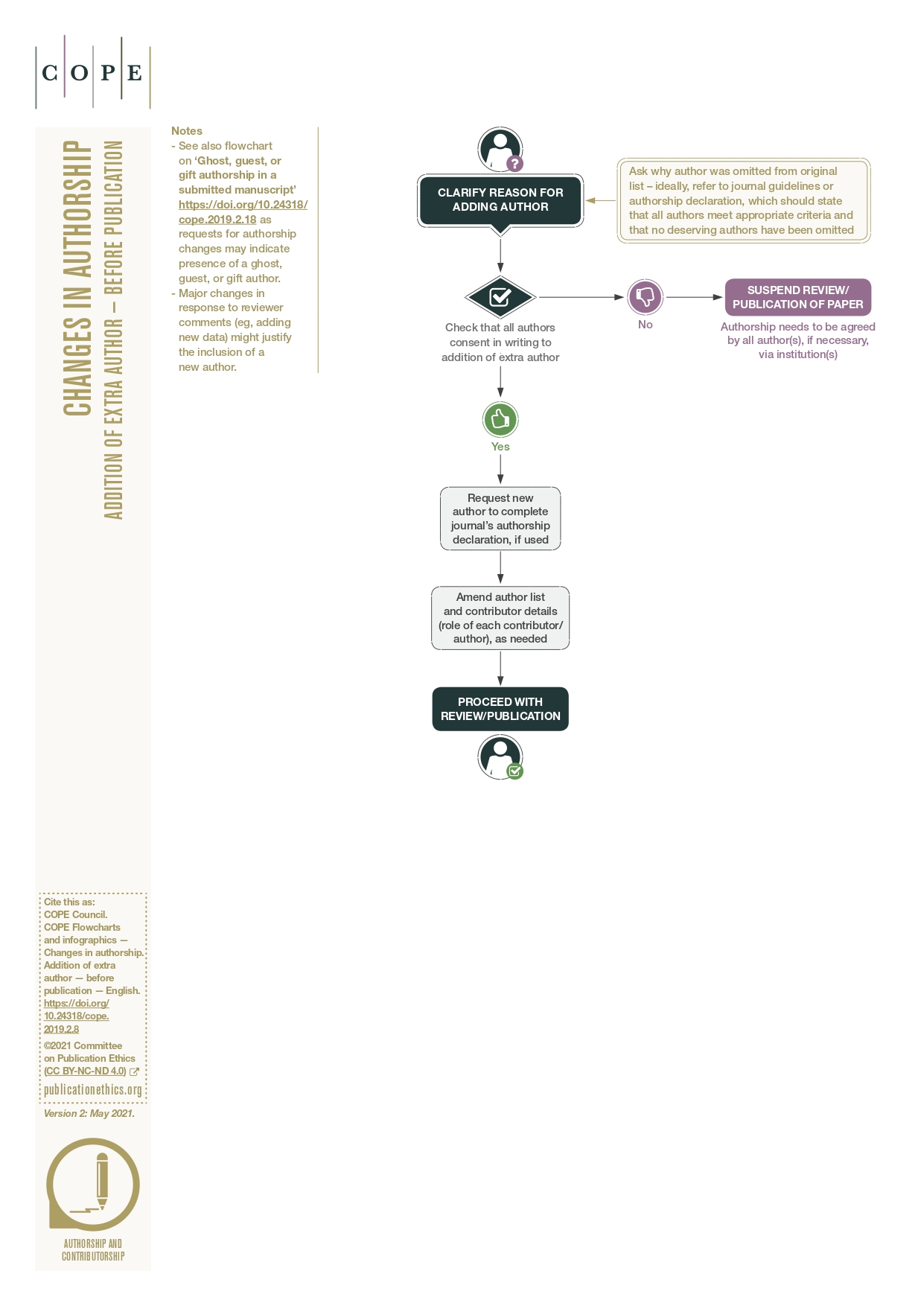
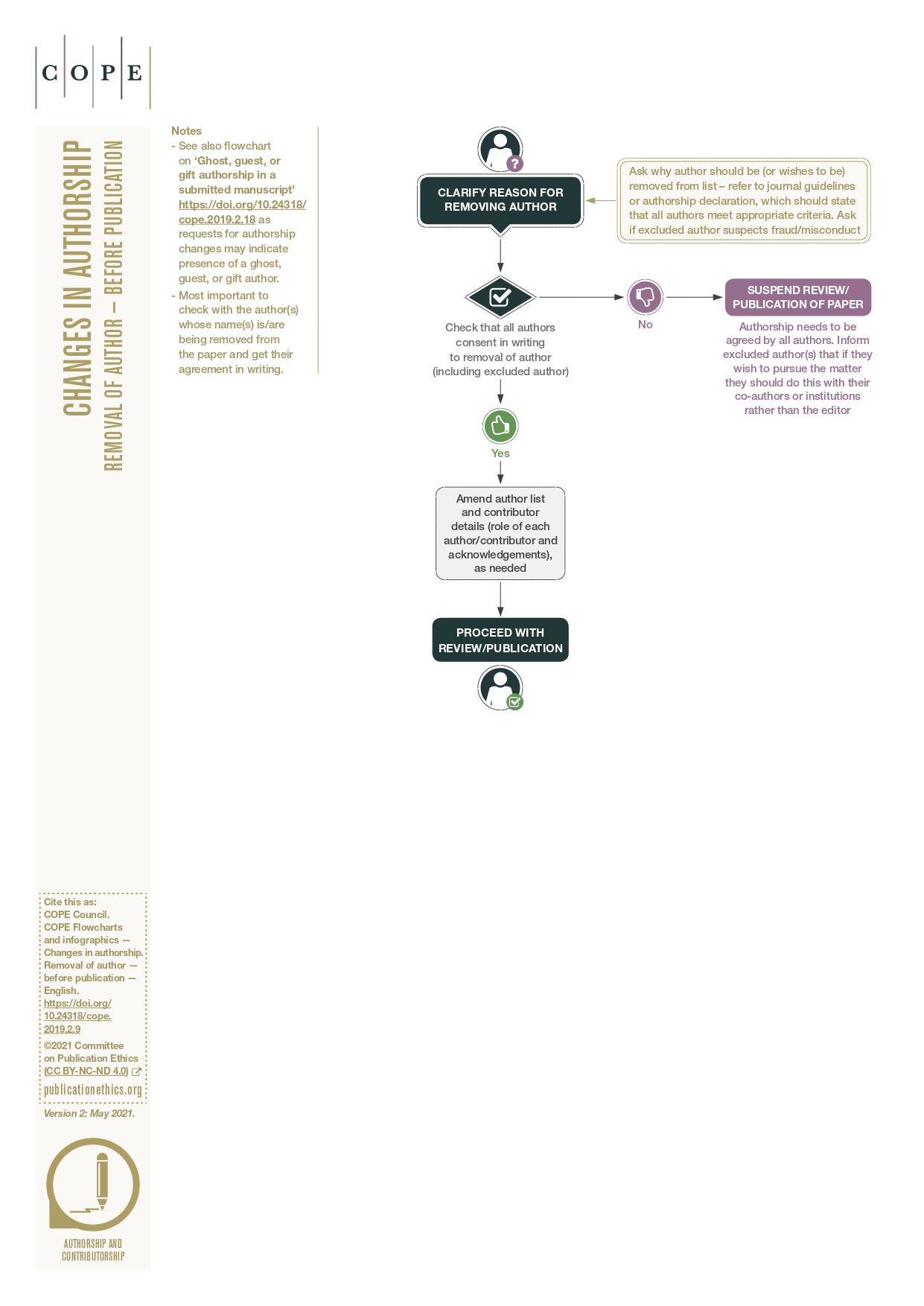
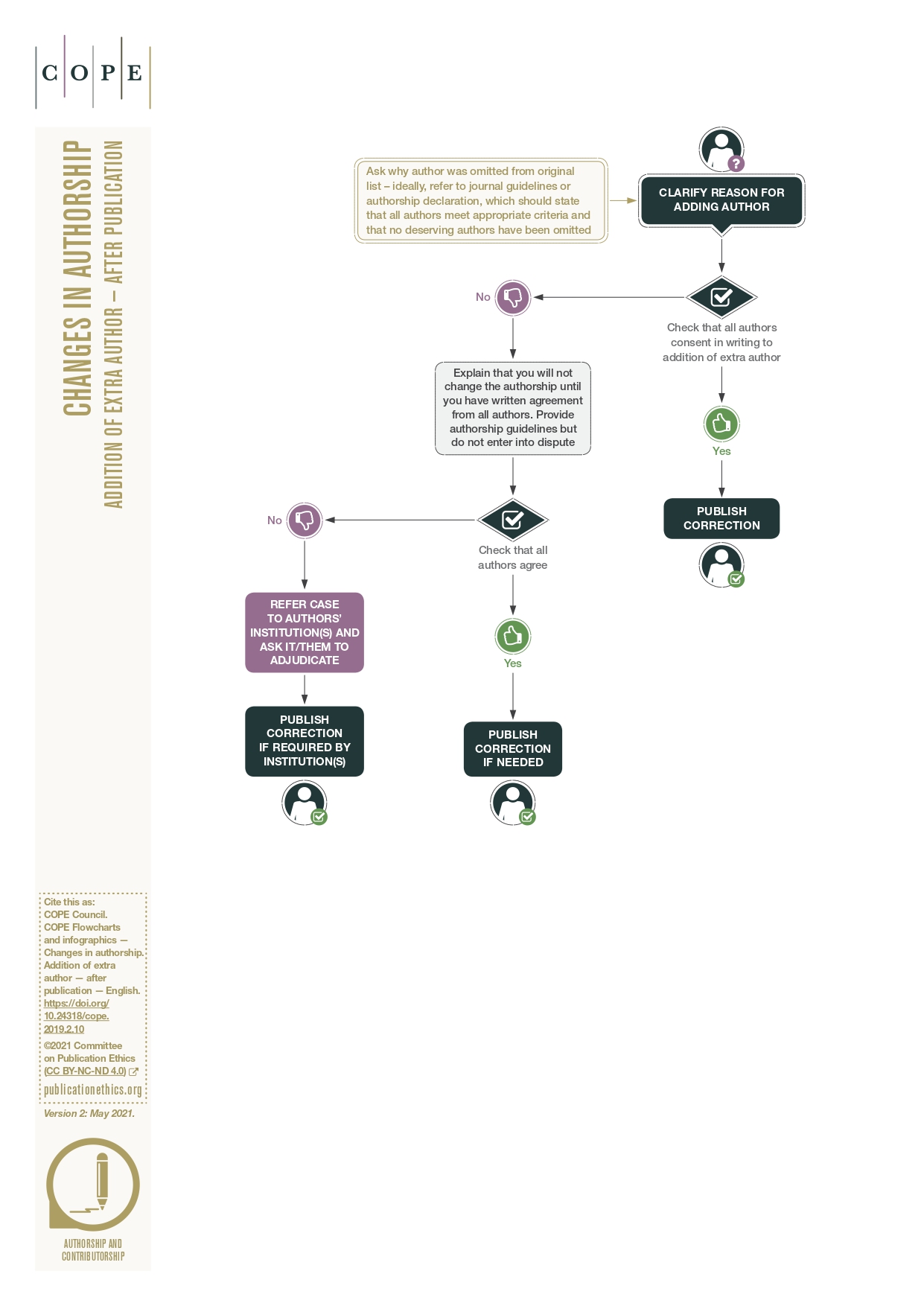
Changes in Authorship